Trip Facts

icon-calendar
Trip Duration 16 Days
icon-meter
Trip Difficulty Moderate
icon-mountain
Maximum Altitude 3,810 m/12,500 ft.
icon-season
Best Season To Visit March-May, June-September, October-November
icon-group
Average Group Size 2-15 pax

Trip Overview

Upper Mustang Trek: Journey to the Forbidden Kingdom of Lo

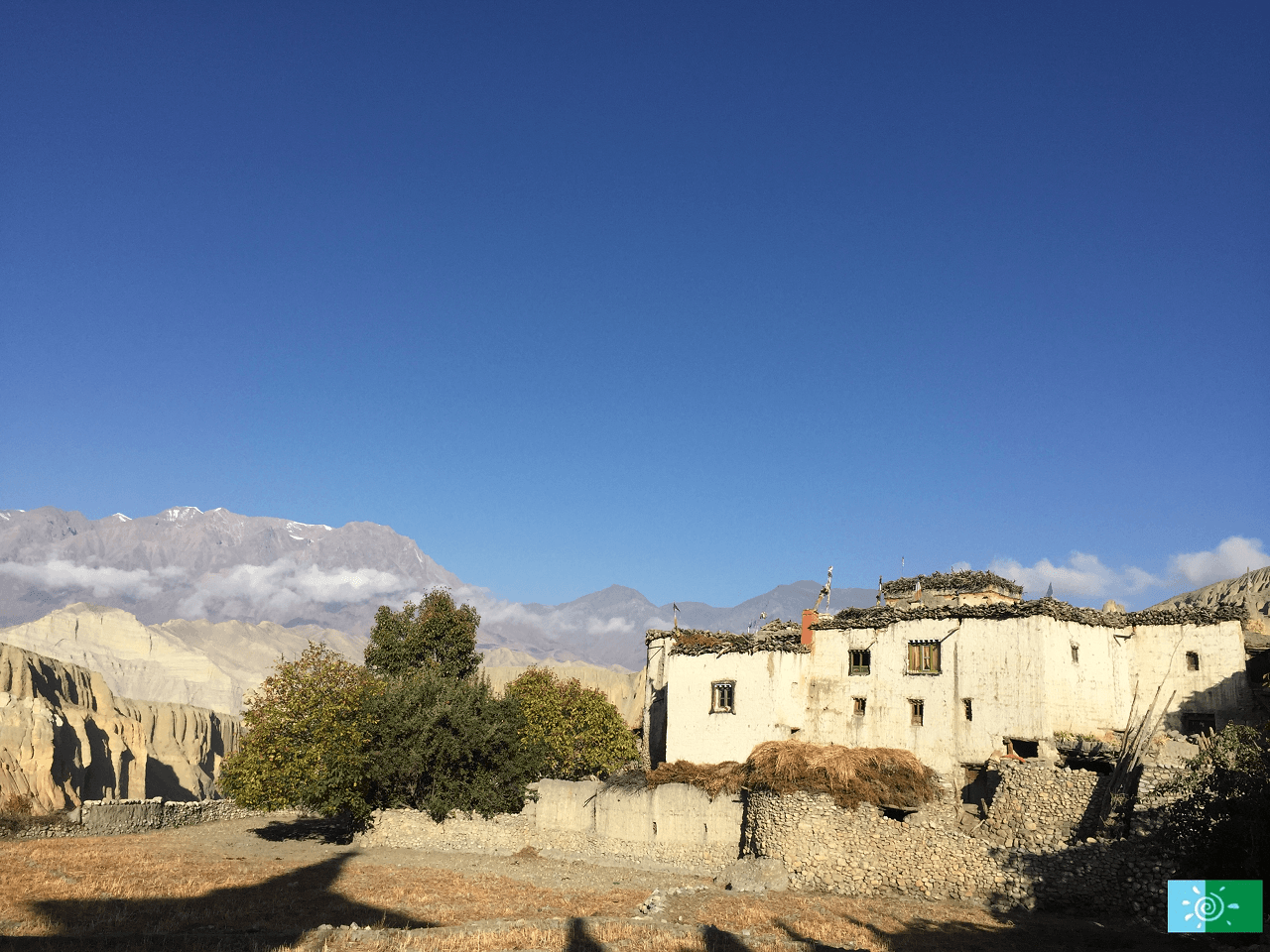
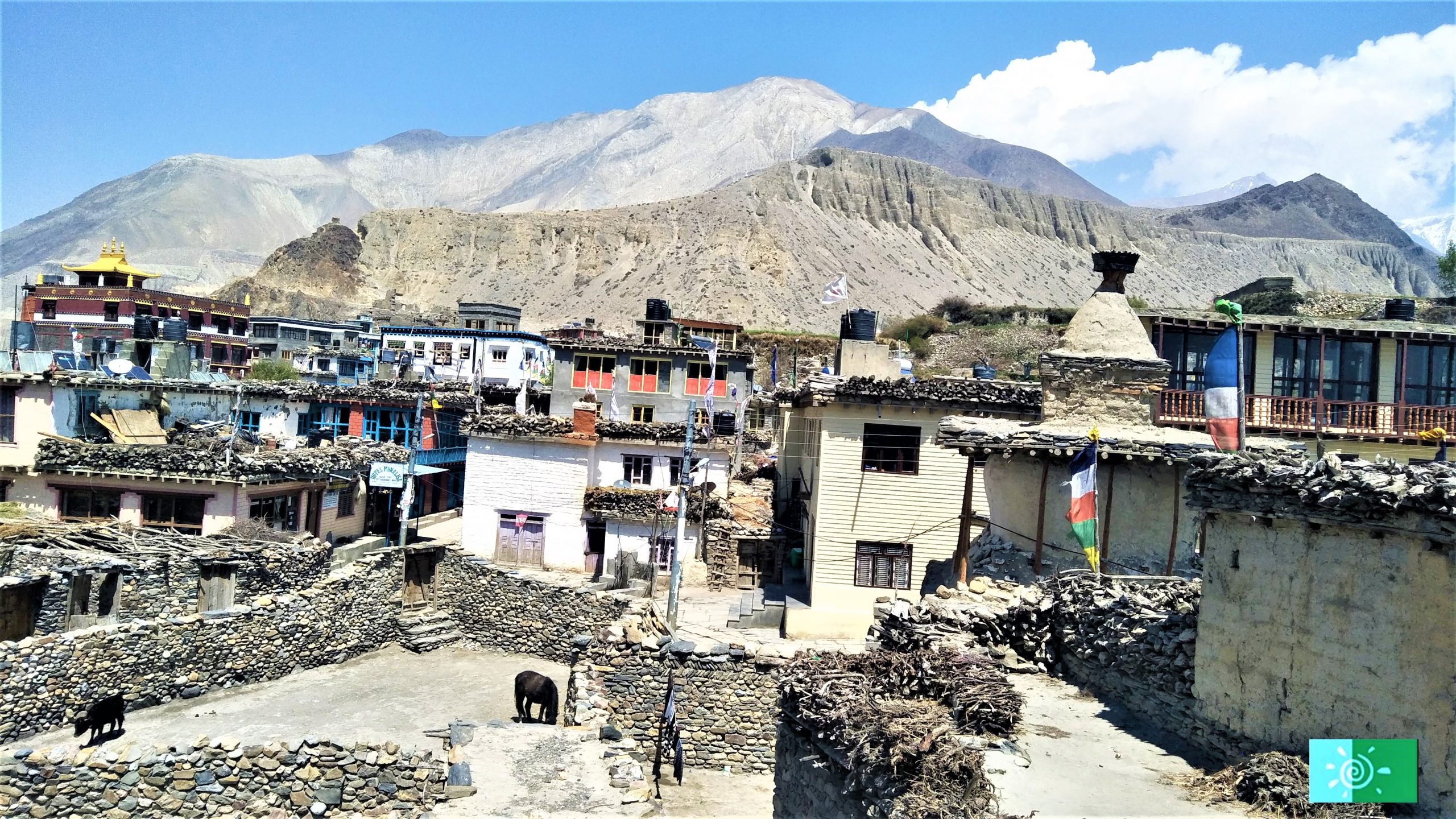
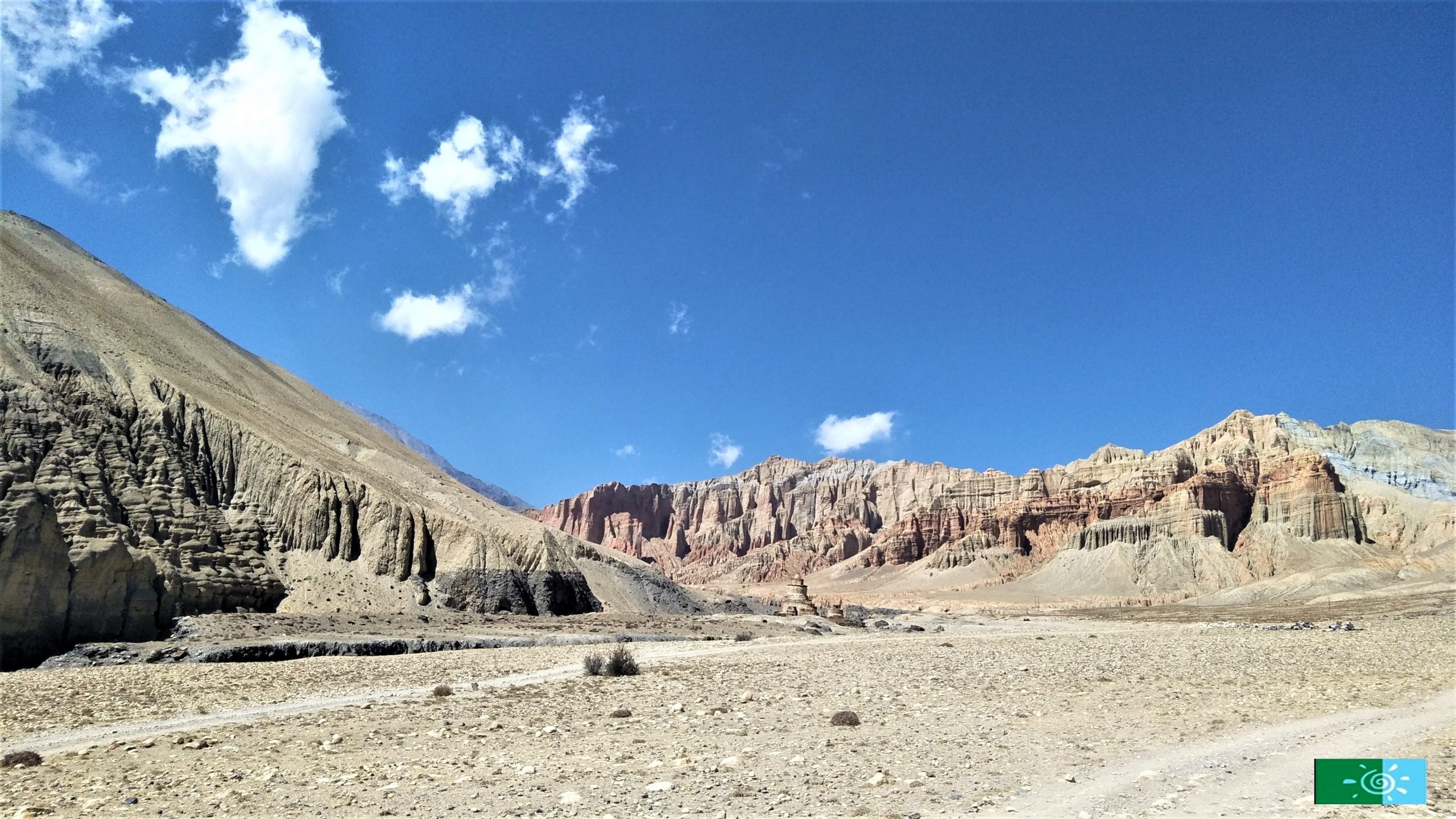
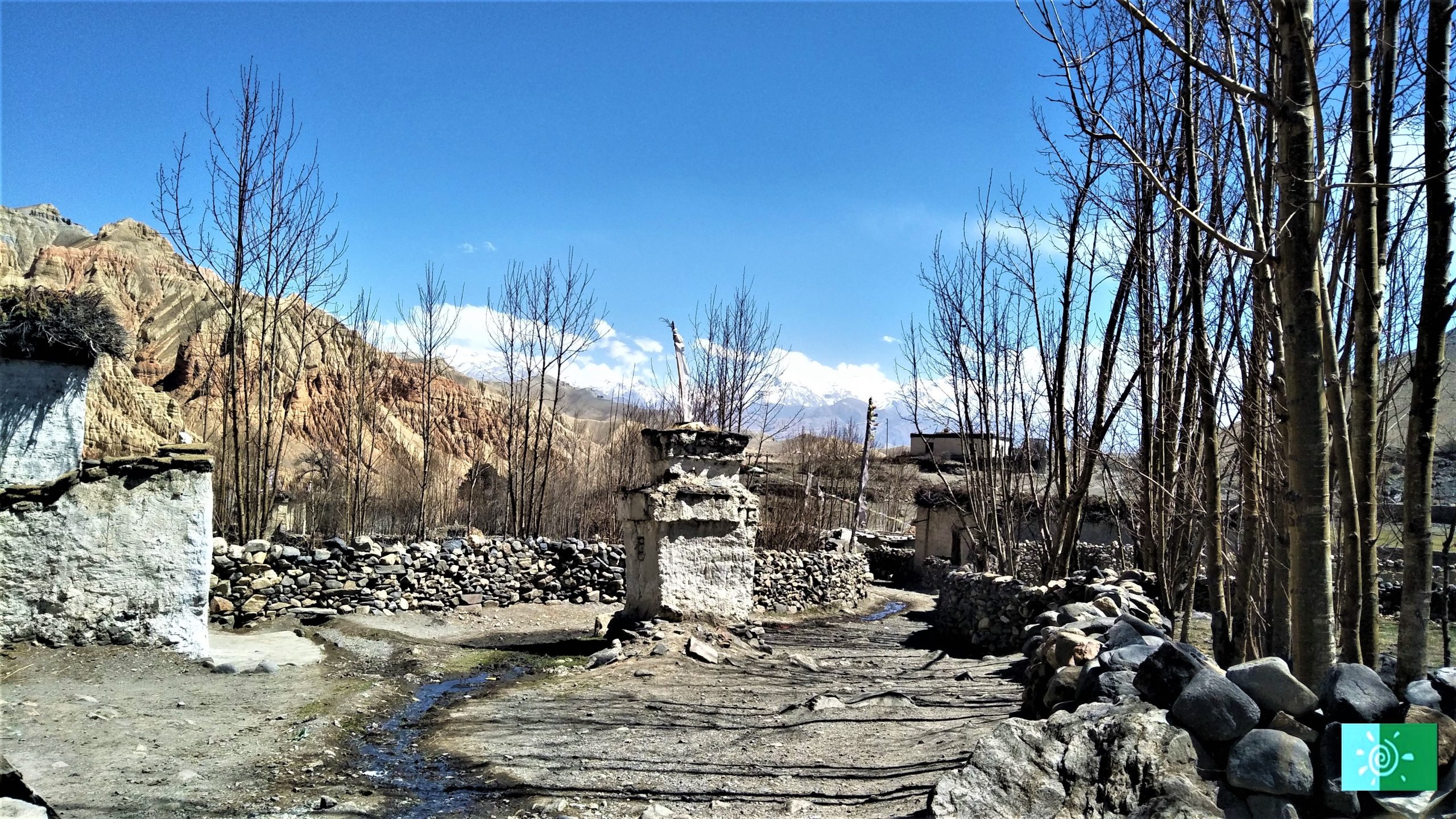
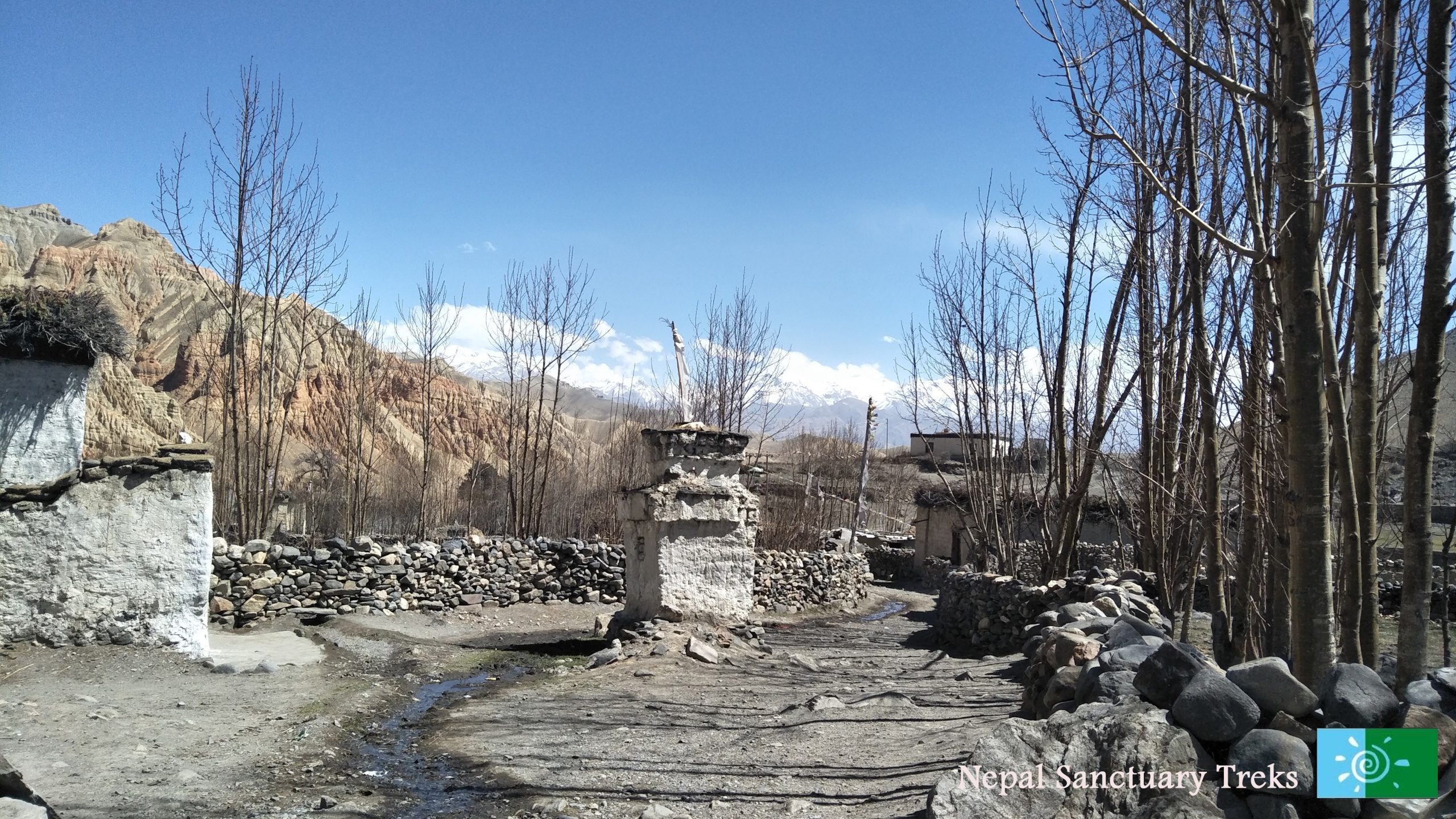
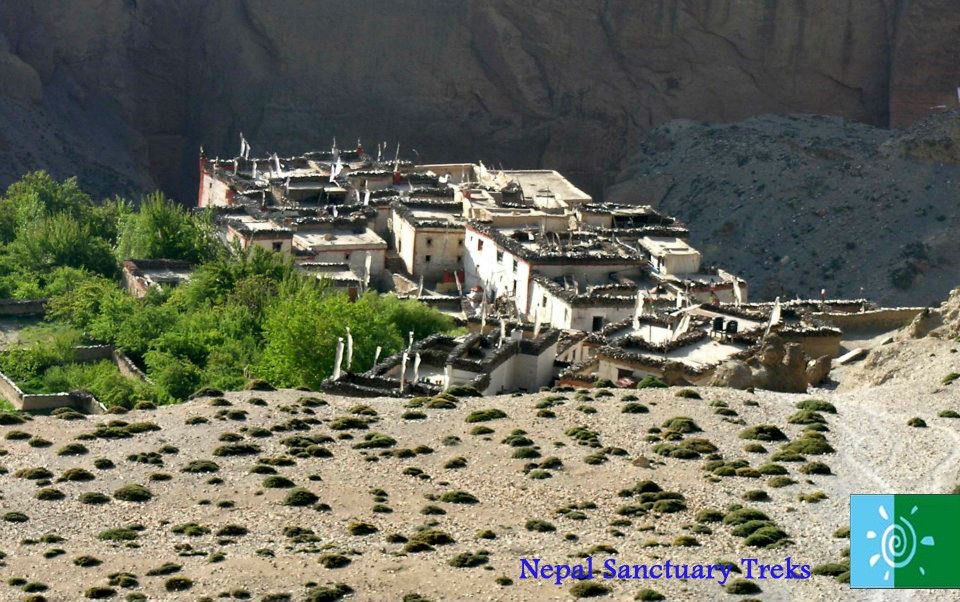
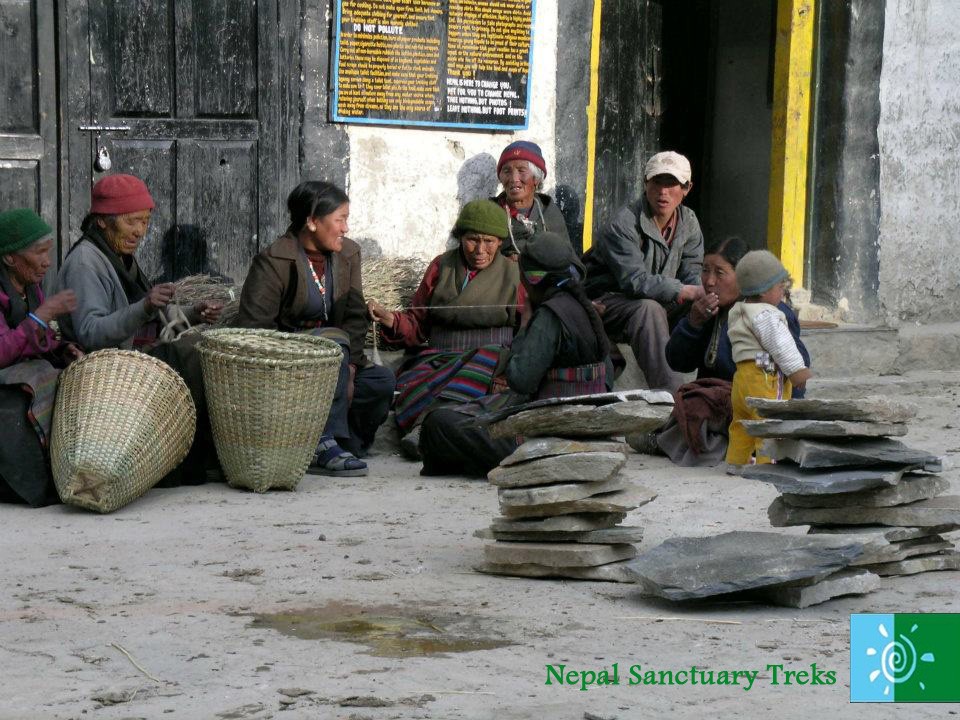
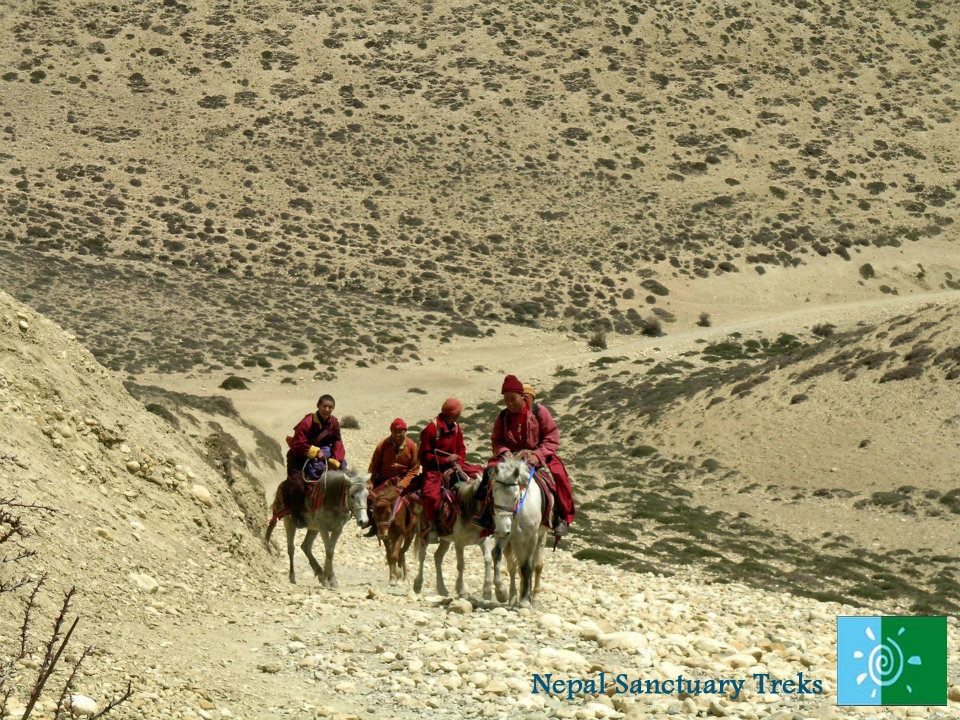
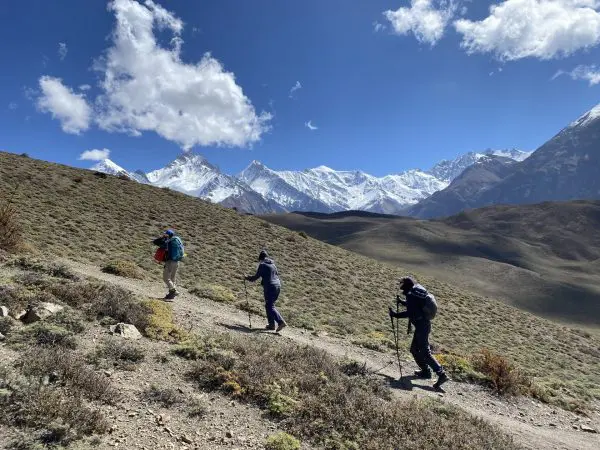
The Upper Mustang Trek offers a chance to explore one of Nepal’s most remote and culturally preserved regions. Known as the “Hidden Kingdom of Lo,” Upper Mustang features high-altitude deserts, red canyons, and ancient Tibetan-style villages that have changed little over centuries.

Upper Mustang remained closed to foreign visitors until 1992, which earned it the name “Forbidden Kingdom.” Today, trekkers can stay in local teahouses instead of camping, making the journey more accessible while still preserving the region’s traditional lifestyle and spiritual atmosphere.

Founded by Ame Pal in the 14th century, the Kingdom of Lo ruled for 25 generations. Because of its cultural and historical importance, Upper Mustang remains a restricted area, and trekkers need a special permit to enter.

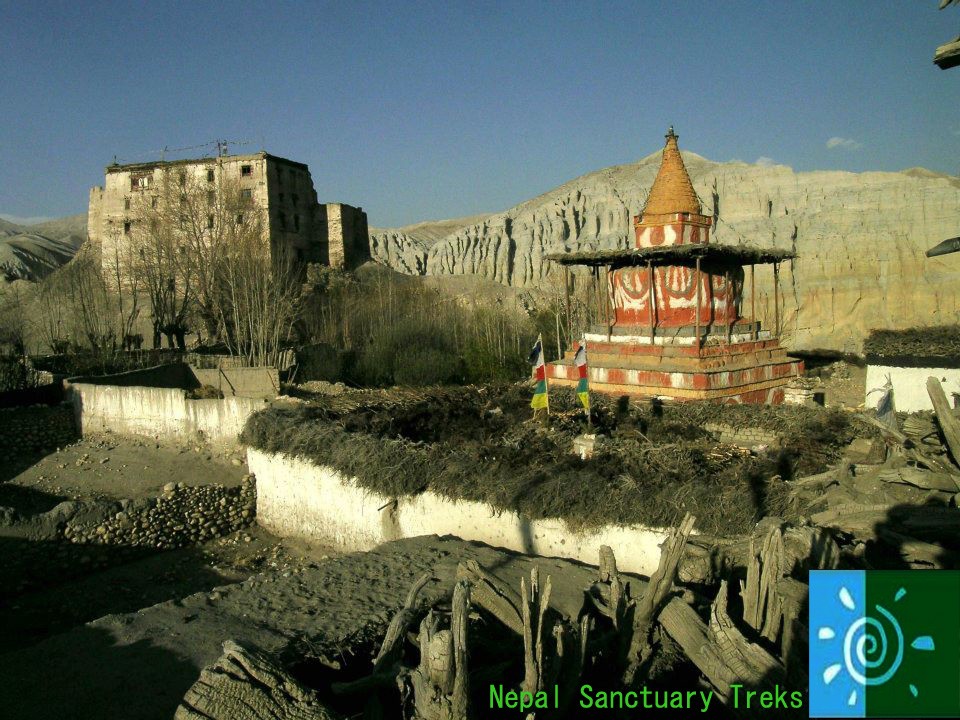
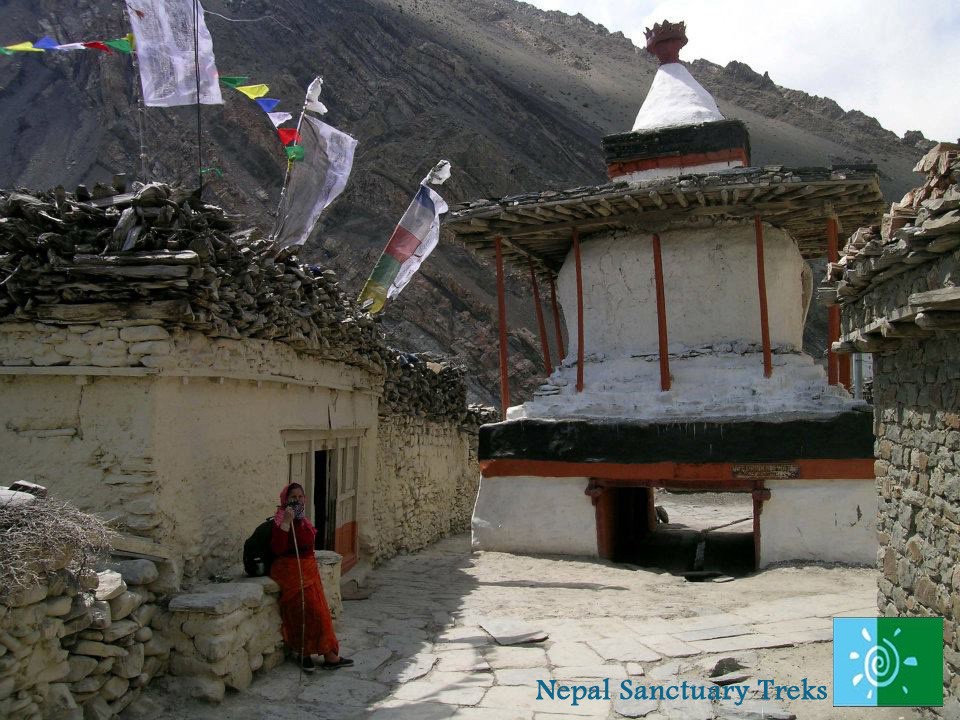
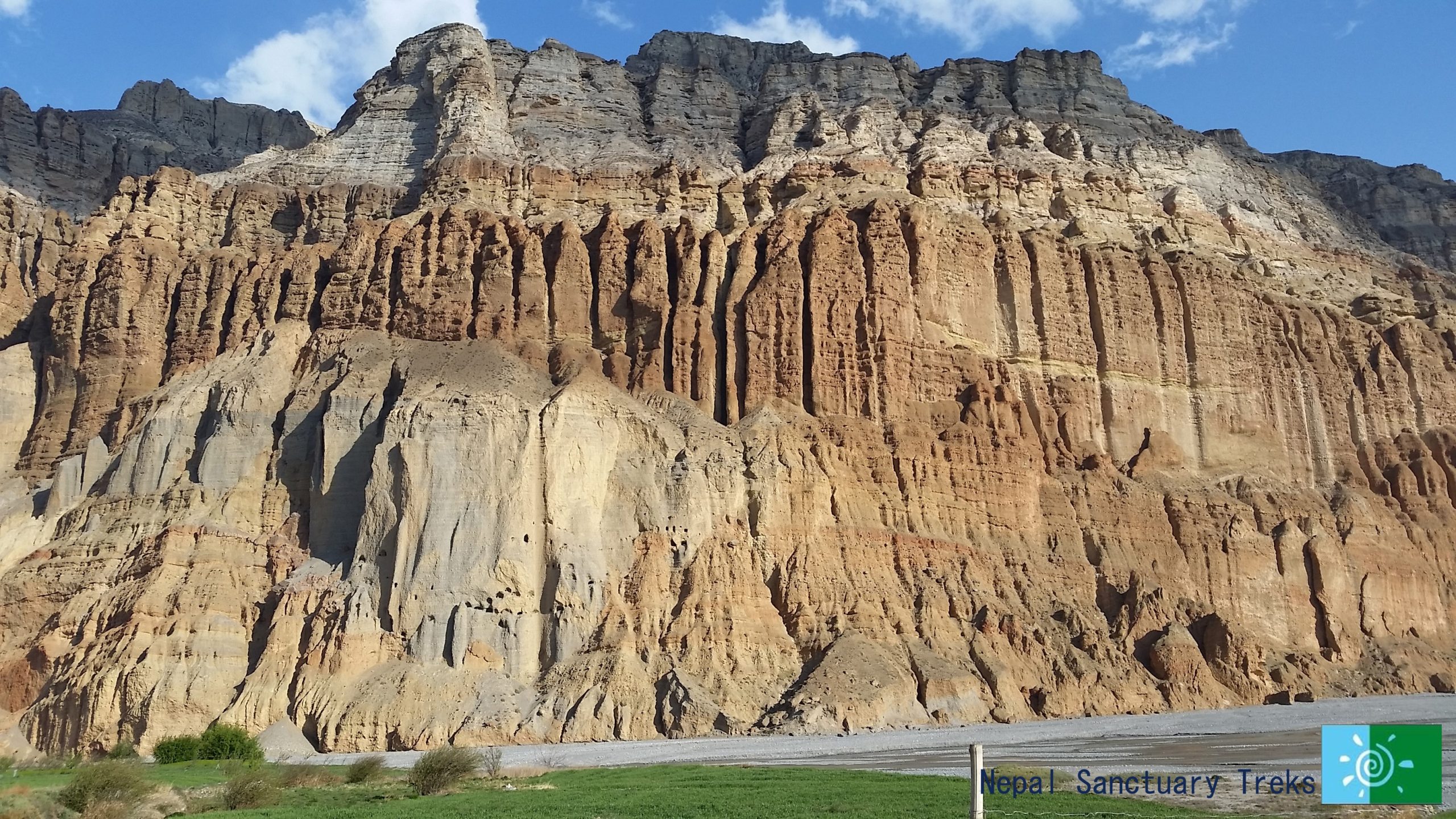
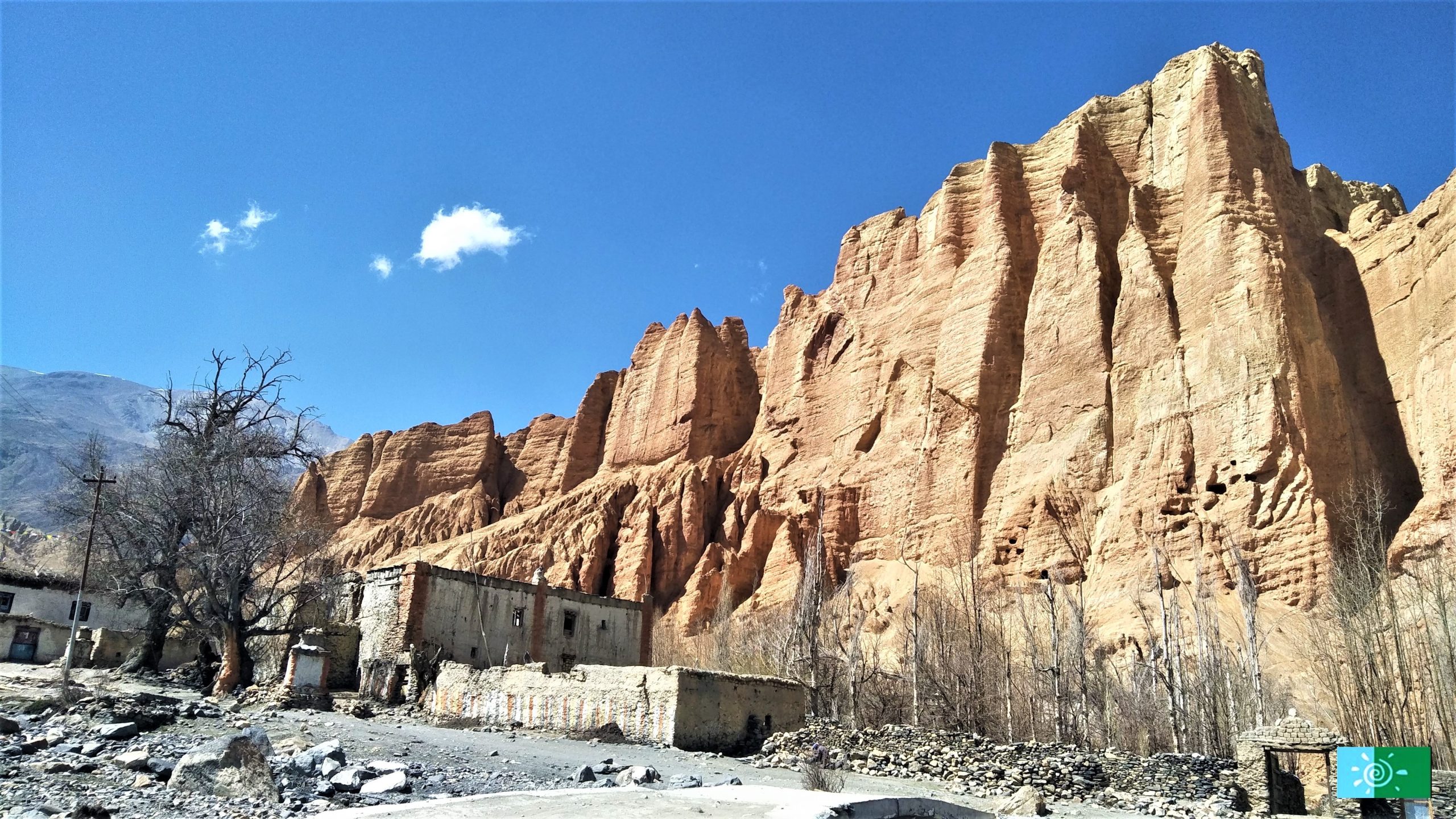
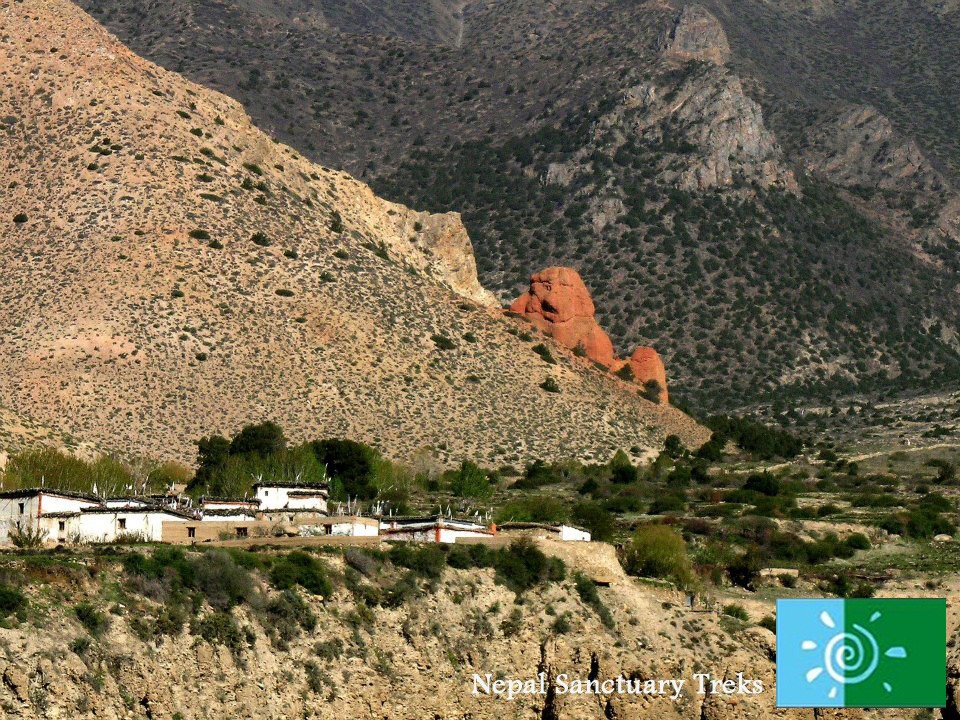
The trail passes through dramatic landscapes shaped by wind and erosion, including red cliffs, deep canyons, and rock formations. You also travel through traditional villages such as Chhusang, Chele, Syangbochen, Ghami, Dhakmar, and Charang.

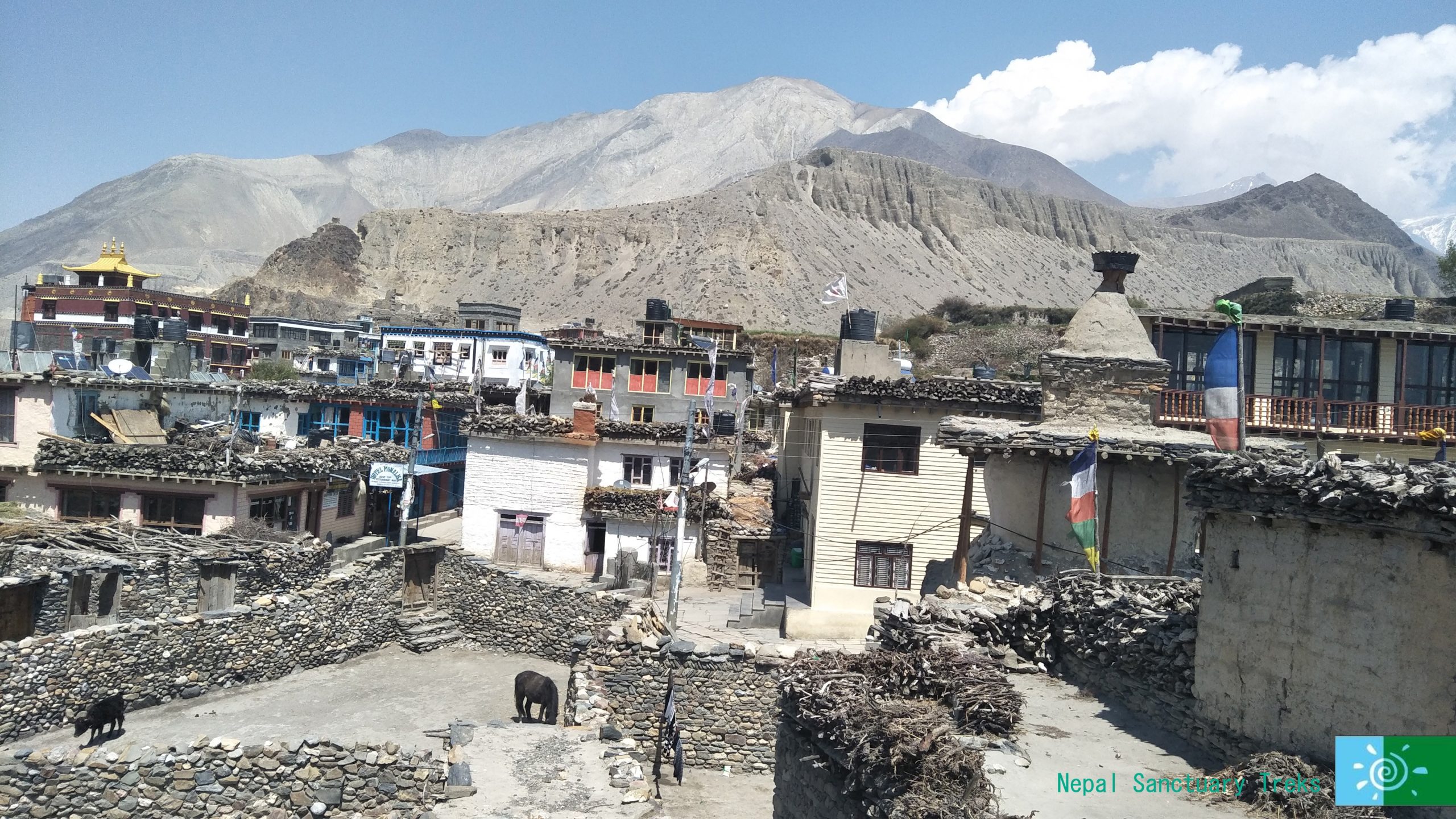
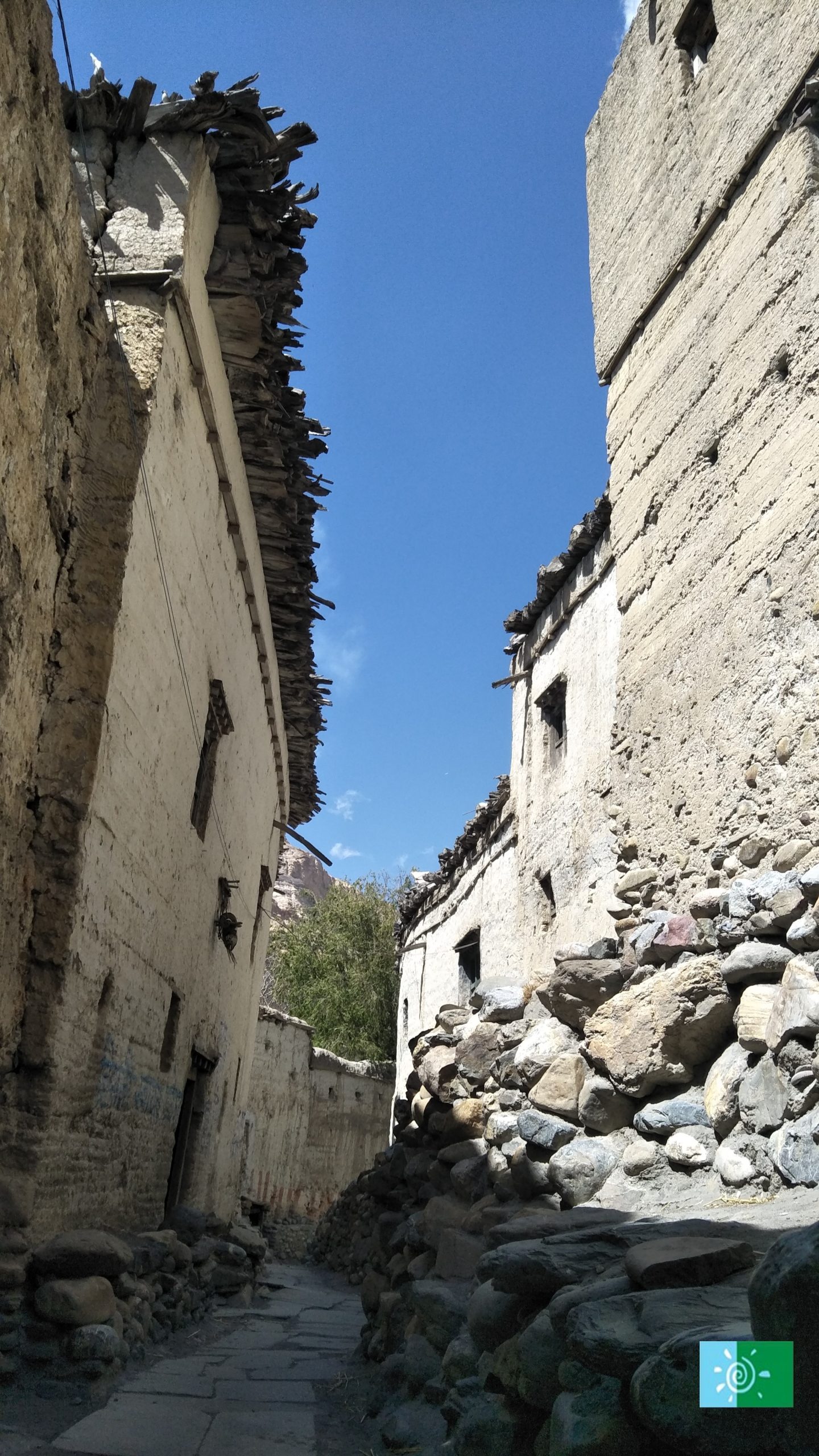
The trek’s main highlight is Lo Manthang, the historic walled capital. Here, you can explore narrow alleys, ancient monasteries like Namgyal Gompa, and the former King’s Palace.

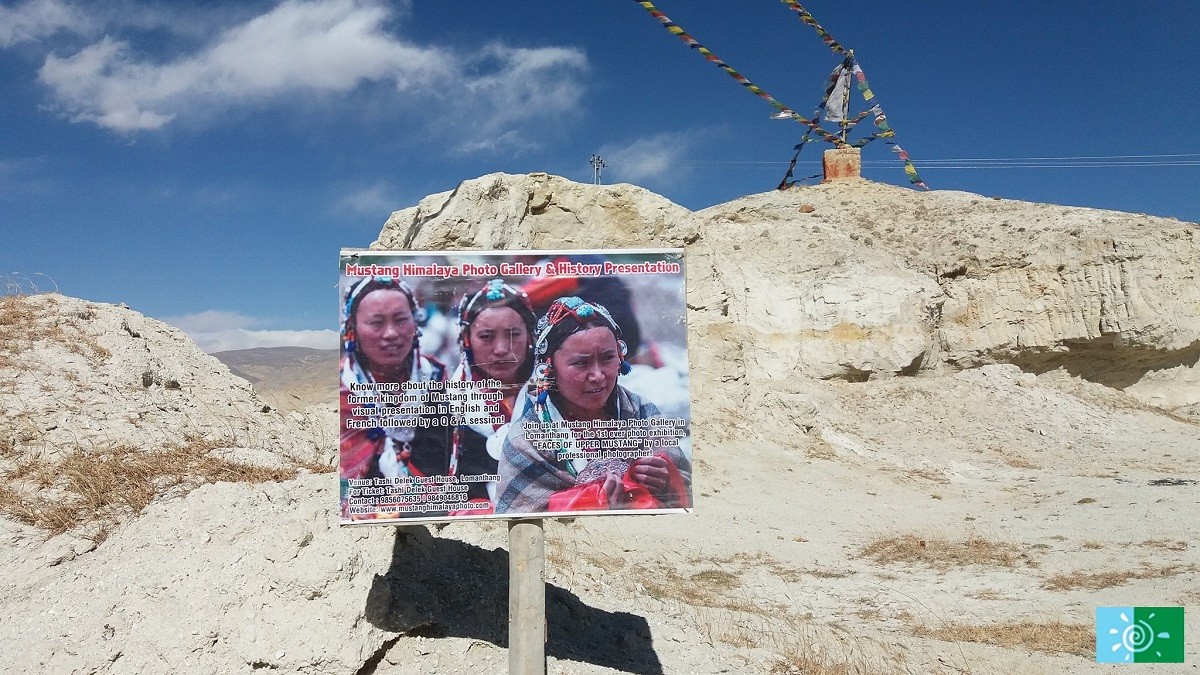
If you visit in mid-May, you can experience the Tiji Festival, a three-day Buddhist celebration featuring masked dances and rituals performed by monks.

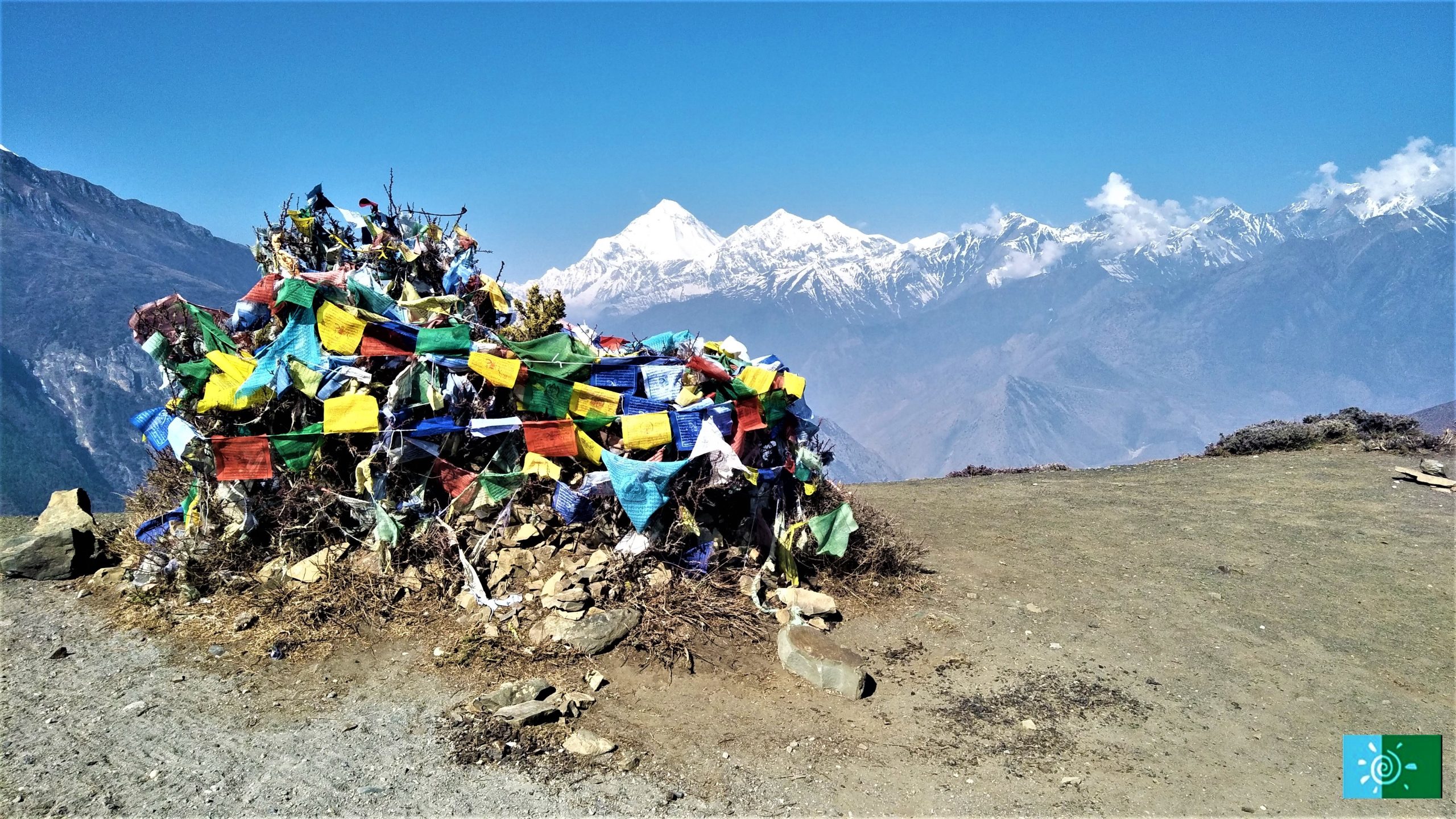
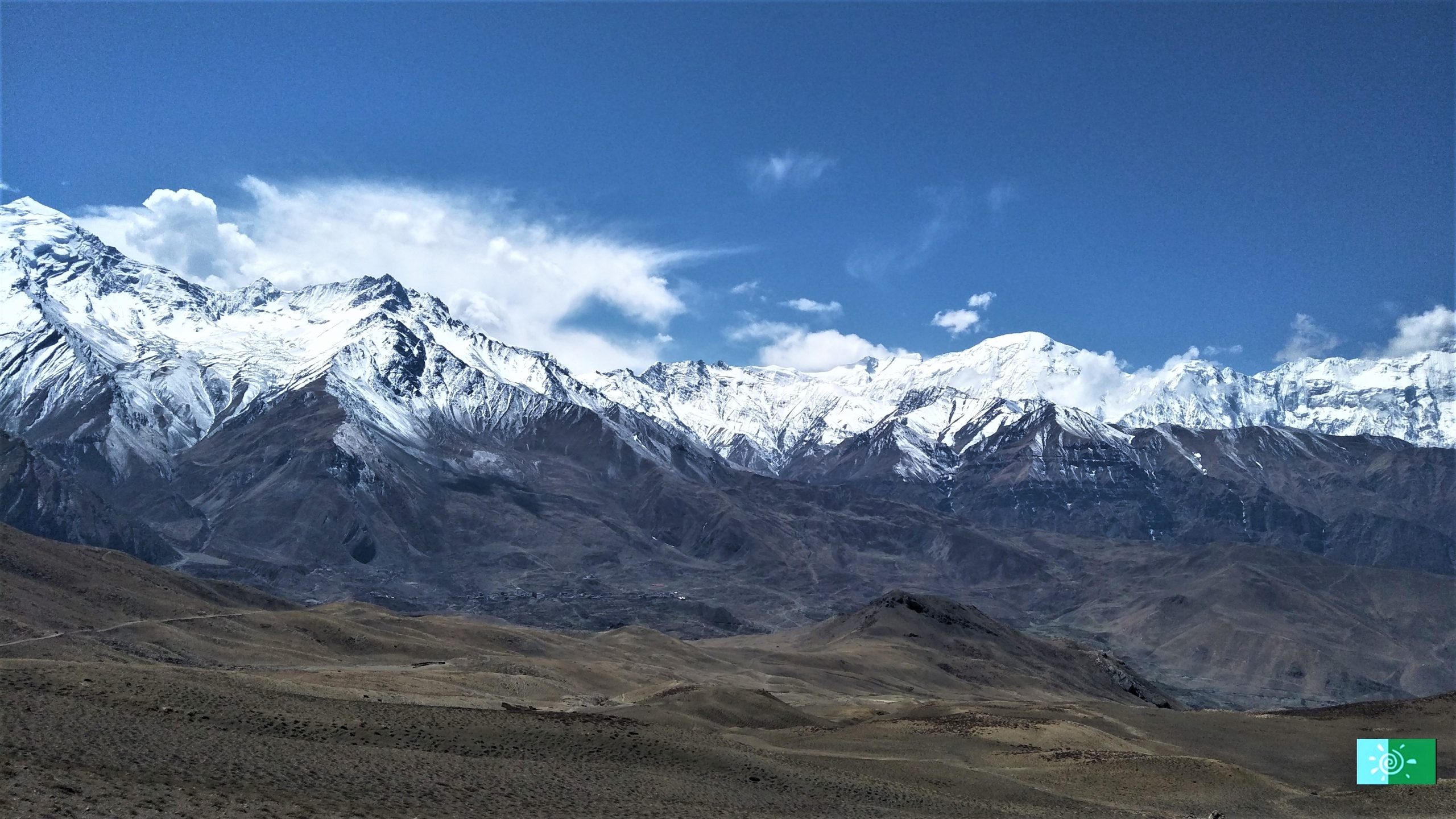
Along the way, the trek also offers wide views of Annapurna, Dhaulagiri, Nilgiri, and Tilicho Peak. Nyi La Pass (3,990 m) is one of the best viewpoints on the route, with panoramic views of Upper Mustang’s rugged landscape.

Why Choose Upper Mustang  Trek with Nepal Sanctuary Treks?

At Nepal Sanctuary Treks, we organize personalized Upper Mustang Treks based on your pace, interests, and fitness level. With more than 27 years of trekking experience in Nepal, we create itineraries that fit your travel style and schedule.

Our experienced trekking guides provide local knowledge, and cultural insights throughout the journey. With years of experience in Upper Mustang, they focus on safety, route planning, and smooth day-to-day trek operations.

We keep our group sizes small so we can offer better coordination and personal support. Safety is our top priority, and we follow clear safety procedures while monitoring altitude-related health conditions during the trek.

We also work with trusted local partners for accommodation, transportation, and logistics. From selected teahouses to reliable transport, we manage every detail carefully.

As a Travelife Certified  trekking agency, we follow responsible travel practices that support local communities and help reduce environmental impact.

Contact us today to plan your tailored Upper Mustang Trek.

Read Trip Advisor Review and Google Review

This is a sample itinerary of the Upper Mustang  Trek . We shall customize the program as per your needs and preferences.

Note: below trekking hours, altitudes and distances are approximate, and absolutely for the general idea only.

Trip Itinerary

Day 01: Arrive at Kathmandu airport

Altitude above sea level: 1,302 m / 4,269 ft.

Driving Time: Approx. 30 minutes, depending on traffic conditions.

Accommodation: Hotel Tibet or similar

Upon your arrival at Tribhuvan International Airport in Kathmandu,, you will be warmly welcomed by our representative, who will be holding a “Nepal Sanctuary Treks” sign outside the terminal to greet you.

You will be transferred to your hotel in a private vehicle. After checking in and freshening up, our representative will meet you to give a detailed briefing on the upcoming itinerary, along with important safety guidelines and hygiene practices to ensure a smooth trek.

Day 02: Cultural Introductory Tour and Trek preparation

Altitude above sea level: 1,302 m / 4,272 ft. – Kathmandu
Accommodation: Hotel Tibet or similar
Meal: Breakfast
It’s also a spare day in case of bad weather in Lukla if we could not fly on the scheduled date and time, or we can organize a guided day tour in or around Kathmandu.

9:00 AM: Guided Cultural Tour of Kathmandu Valley
Start your day with a guided cultural tour around Kathmandu Valley. Explore the vibrant Kathmandu with our expert guides, who will share insights into the area’s rich history.

Kathmandu Durbar Square
Visit Kathmandu Durbar Square (Hanuman Dhoka Durbar), a historical royal complex with temples, palaces, and shrines dating back to the 15th century. Key attractions include Kumari Ghar (the house of the living goddess) and Kasthamandap, built from a single tree.

Swayambhunath (Monkey Temple)
Next, head to Swayambhunath, the Monkey Temple, a sacred site for both Hinduism and Buddhism. Admire the stunning white dome and golden spire, while soaking in the serene atmosphere filled with incense and prayer wheels.

PM: Boudhanath Stupa
Visit the massive Boudhanath Stupa, a UNESCO World Heritage Site. It’s a spiritual center for Tibetan culture, surrounded by prayer flags, monks, and devotees chanting ‘Om Mani Padme Hum’.

Pashupatinath Temple
Conclude your tour at the Pashupatinath Temple, one of the most sacred Hindu temples, located along the Bagmati River. Here, you can witness profound spiritual rituals, including the moving sight of open-air cremations, which hold deep cultural significance.

After immersing yourself in this sacred experience, you will return to your hotel to relax and prepare for your upcoming Upper Mustang Trek.

Day 03: Flight to Pokhara

Altitude above sea level: 895 m / 2,936 ft. – Pokhara
Flight duration: Approximately 25 minutes
Accommodation: Mount Kailash Resort or similar
Meal: Breakfast

This morning, you’ll be transferred to the domestic airport for a short flight to Pokhara. On clear days, enjoy stunning views of the Annapurna mountain range. After arriving in Pokhara, you’ll be escorted to your hotel, where you can relax or explore the city at your leisure.  Get ready for tomorrow’s Upper Mustang Trek journey, as your adventure through this mystical region begins.

Day 04: Flight to Jomsom- Drive Kagbeni- Hike to Tiri village

Altitude above sea level: 2,800 m / 9,186 ft. – Kagbeni
Flight duration: Approximately 25 minutes
Driving duration: Approximately 30 minutes (Jomsom → Kagbeni)
Hiking duration: 2–3 hrs. approx. (5.4 km / 3.37 mi)
Ascent: 217 m / 712 ft.
Descent: 217 m / 712 ft.
Accommodation: Teahouse Lodge
Meals: Breakfast, Lunch & Dinner

Begin your adventure with a hearty breakfast in Pokhara before boarding a scenic domestic flight to Jomsom. During the flight, enjoy breathtaking aerial views of the Annapurna and Dhaulagiri Himalayan ranges.

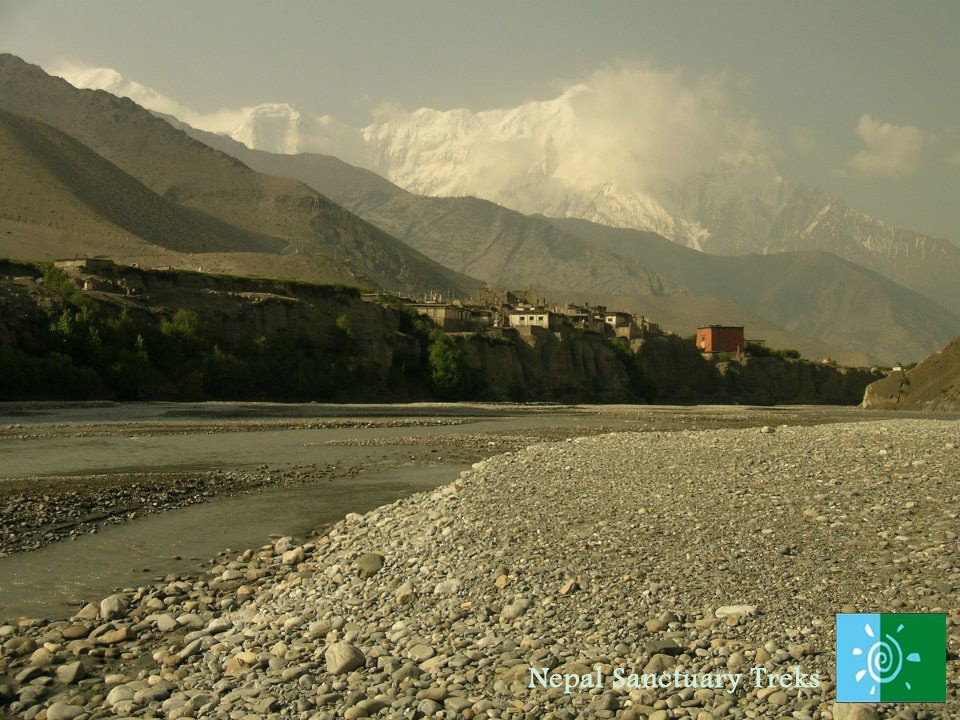
After landing in Jomsom, take a picturesque 30-minute drive to Kagbeni, a historic Himalayan village in Upper Mustang. Check into a cozy teahouse lodge, freshen up, and explore the charming village of Tiri. Join a guided hike to a nearby viewpoint, where panoramic valley views create the perfect setting for landscape photography and quiet moments in nature.

While in Tiri, visit the ancient Sandup Choeding Monastery, dramatically perched on a heart-shaped rock. For more than 860 years, this spiritual landmark has served the local community. Although fire once damaged the monastery, monks and nuns carefully restored it, preserving its rich cultural and religious heritage.

Day 05: Trek to Chele

Altitude above sea level: 3,050 m / 10,007 ft. – Chele
Hiking duration: Approximately 5–6 hours (14.7 km / 9.13 mi)
Ascent: 760 m / 2,493 ft.
Descent: 584 m / 1,916 ft.
Accommodation: Teahouse Lodge
Meals: Breakfast, Lunch, and Dinner

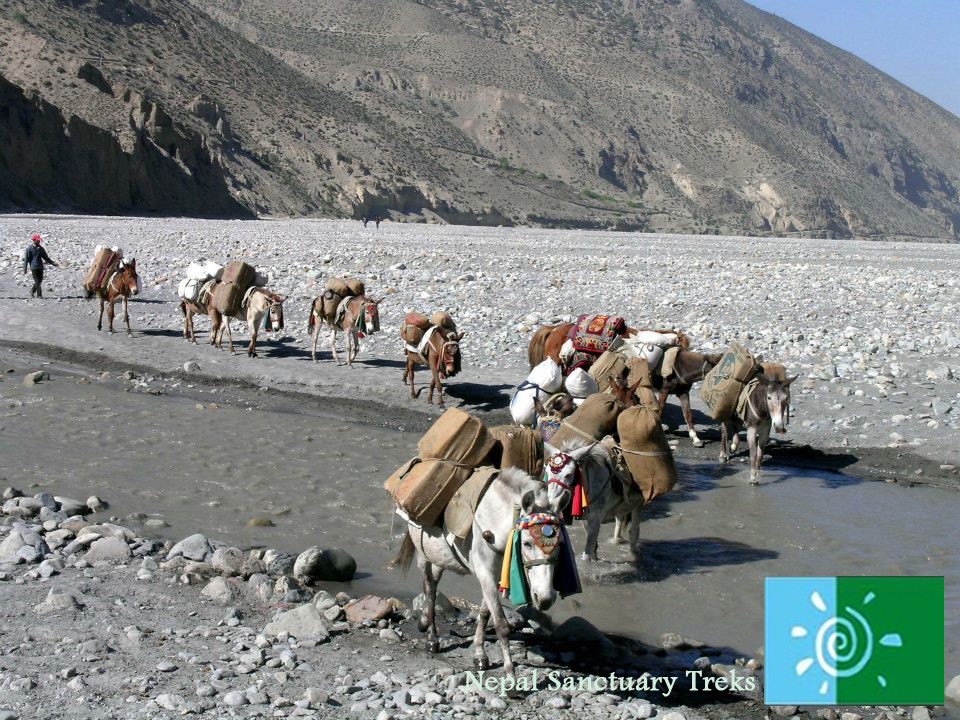
After a hearty breakfast, begin your trek into Upper Mustang. Follow the Kali Gandaki River as strong winds sweep through the dramatic valley gorge. The trail climbs gradually from Kagbeni along a scenic ridge, rewarding you with breathtaking mountain and landscape views.

Continue with a steep ascent before the trail levels into a gentler climb toward Tangbe village. This charming settlement features narrow cobbled lanes, whitewashed houses, buckwheat fields, and flourishing apple orchards. From Tangbe, trek onward to Chhusang village, dramatically perched on a cliff above the Kali Gandaki Gorge and surrounded by striking rock formations.

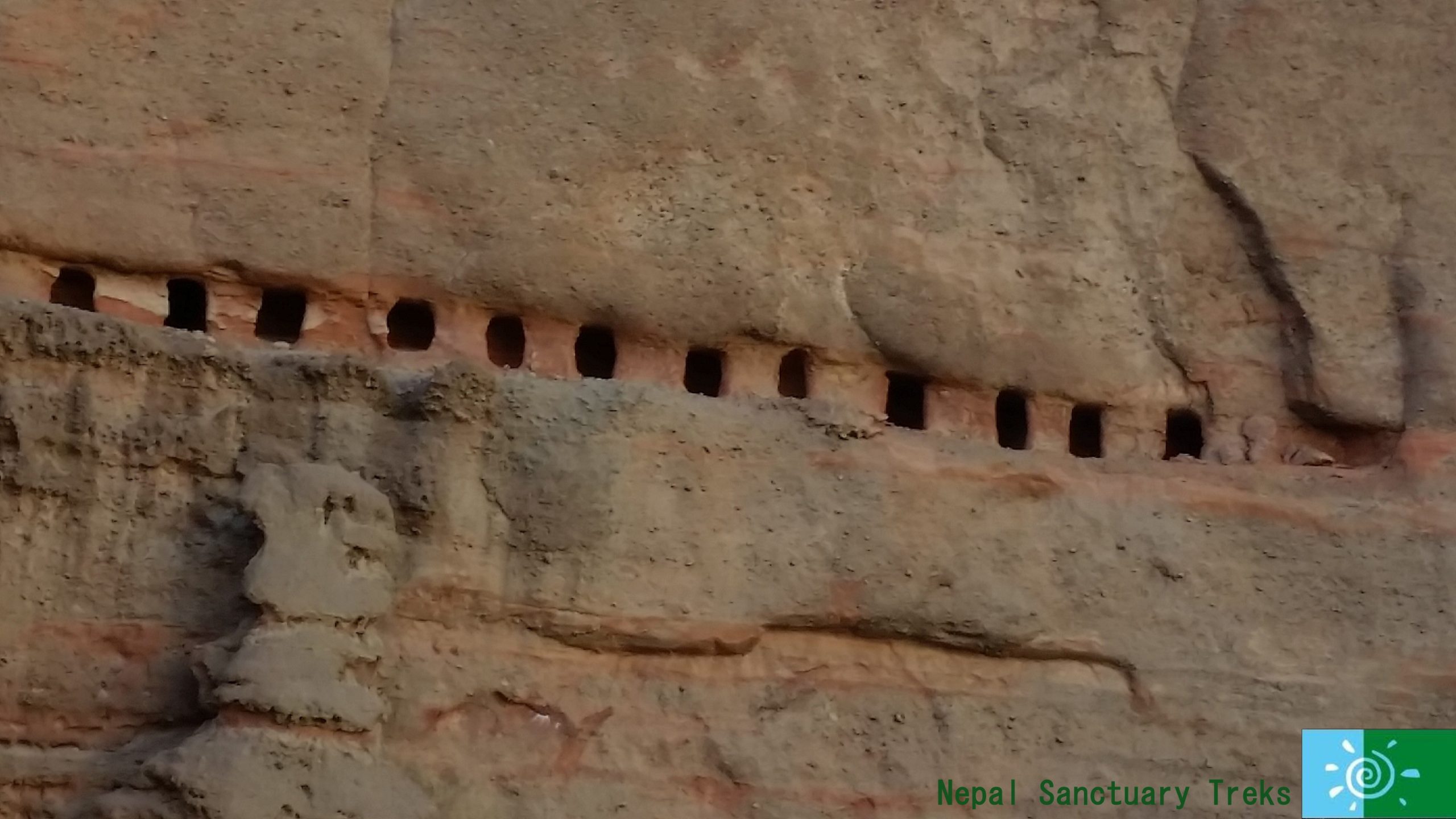
The trail then follows the river, crossing a steel bridge beneath ancient cave dwellings carved into the cliffs, their window-like openings visible high above. Finally, tackle a short but steep ascent to Chele village, where sweeping panoramic views of the valley await.

Day 06: Trek to Syanbochen

Altitude above sea level: 3,475 m / 11,404 ft. – Syanbochen
Hiking duration: Approximately 6–7 hours (14.7 km / 9.13 mi)
Ascent: 760 m / 2,493 ft.
Descent: 584 m / 1,916 ft.
Accommodation: Teahouse Lodge
Meals: Breakfast, Lunch, and Dinner

After breakfast, depart from Chele and begin your trek toward Syanbochen. Today’s journey is more demanding as you cross two high mountain passes: Taklam La (3,624 m) and Darjori La (3,735 m). Along the way, enjoy spectacular mountain panoramas, a striking copper-red canyon, and fascinating caves that make memorable stops during the climb.

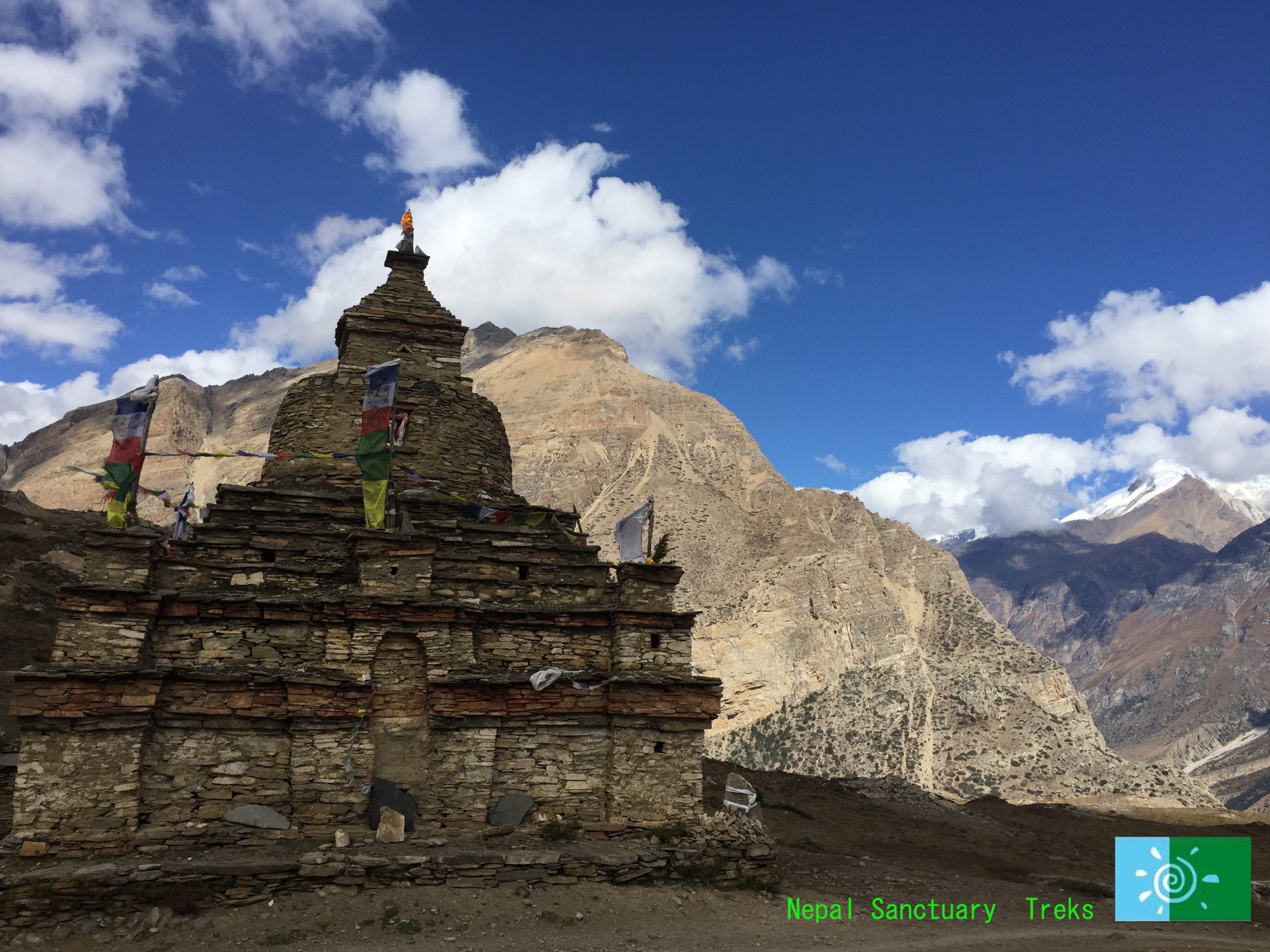
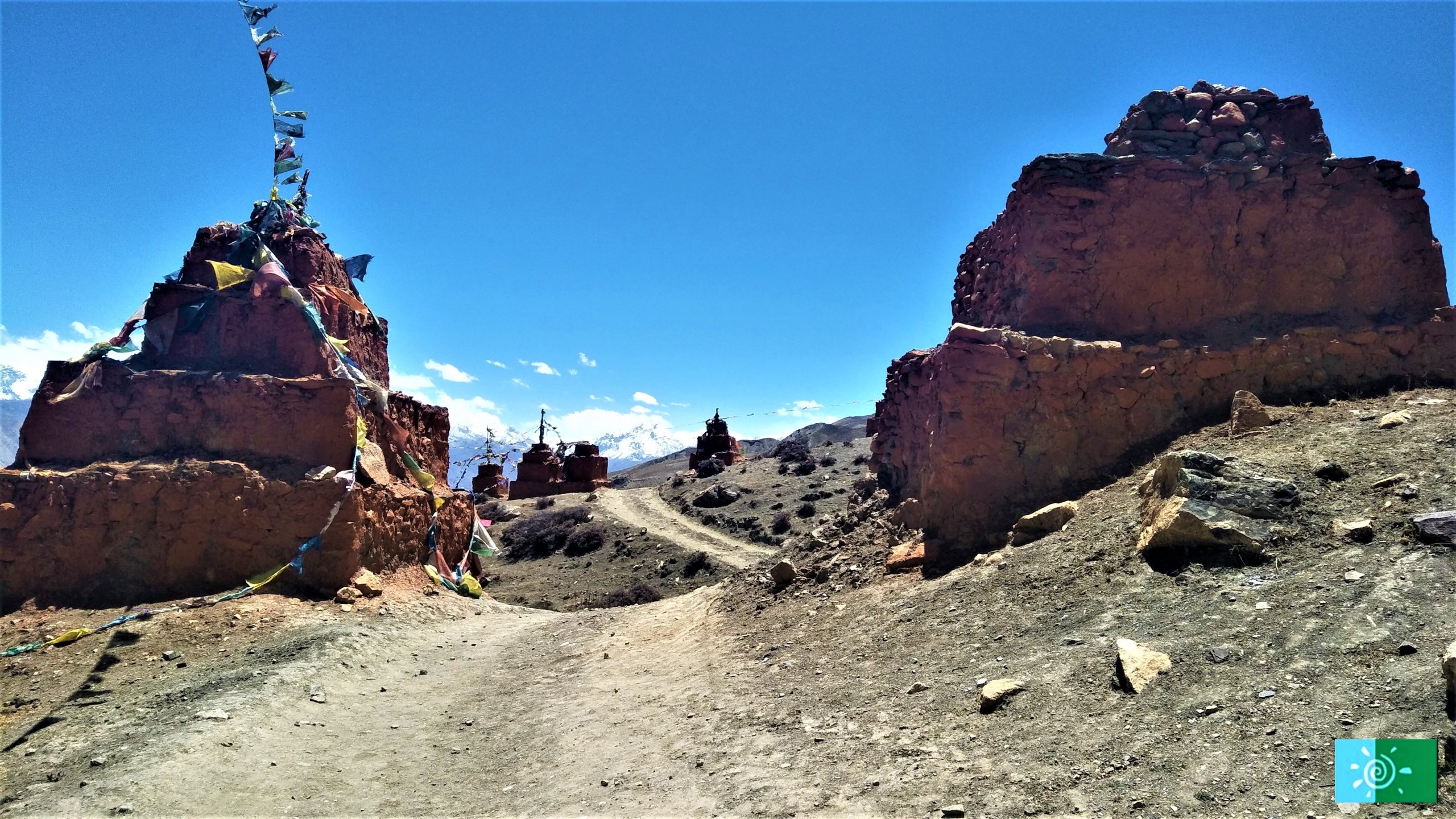
After descending from the passes, follow a gentle trail along a ridge lined with chortens before continuing downhill to the charming village of Samar.

Day 07: Trek to Charang via Ghami

Altitude above sea level: 3,500 m / 11,483 ft.-Charang
Hiking duration: Approximately 6–7 hours (10.7 km / 6.6 miles)
Ascent: 345 m / 1,132 ft.
Descent: 635 m / 2,083 ft.
Accommodation: Teahouse Lodge
Meals: Breakfast, Lunch, and Dinner

After breakfast, leave Syangbochen and continue your journey toward Charang. The trail begins with a gradual climb to a 3,770 m pass before descending into the village of Gheling. This large settlement is famous for its impressive 15th-century monastery, which sits beneath a rocky hillside surrounded by terraced fields.

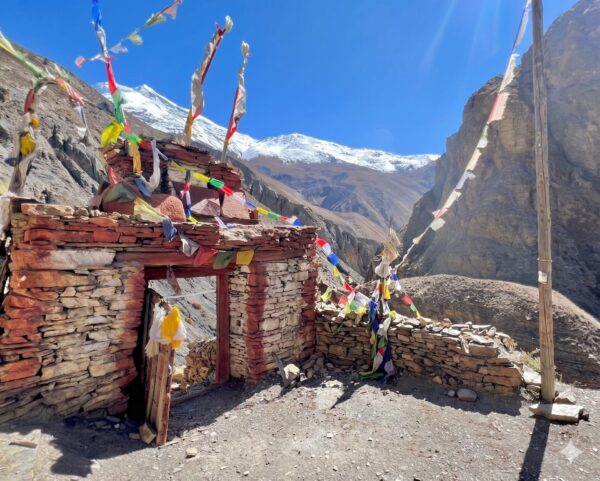
From Gheling, follow the trail through farmland as it climbs gently toward the head of the valley. The route then crosses rocky terrain before reaching Nyi La Pass at 3,840 m. After enjoying the mountain views, descend for about 30 minutes to a trail junction. The right-hand trail leads to Charang, while the left heads toward Ghami.

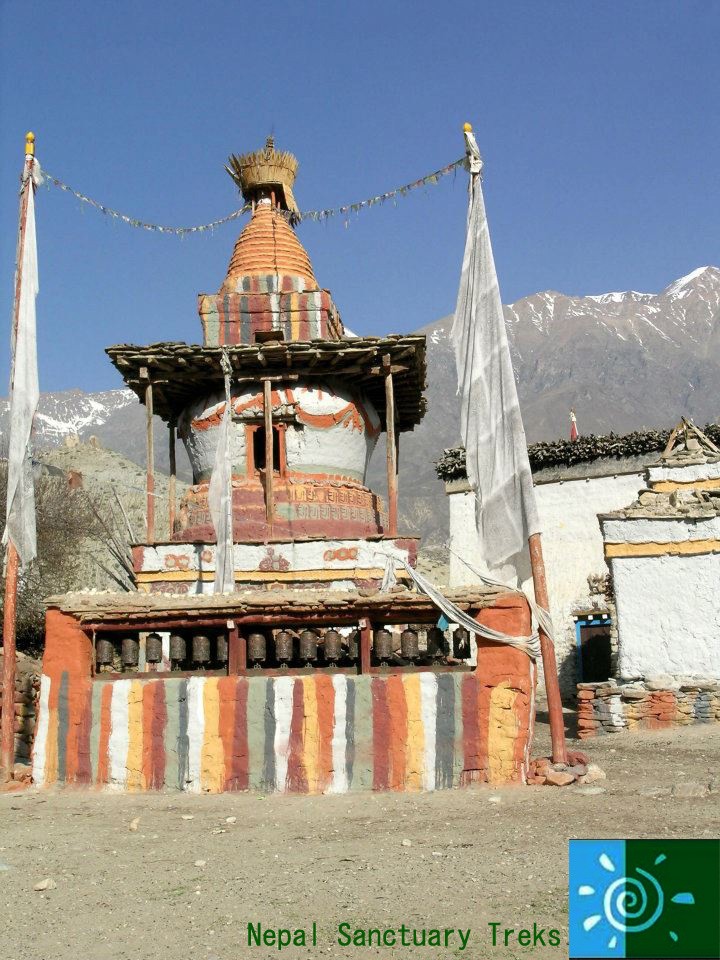
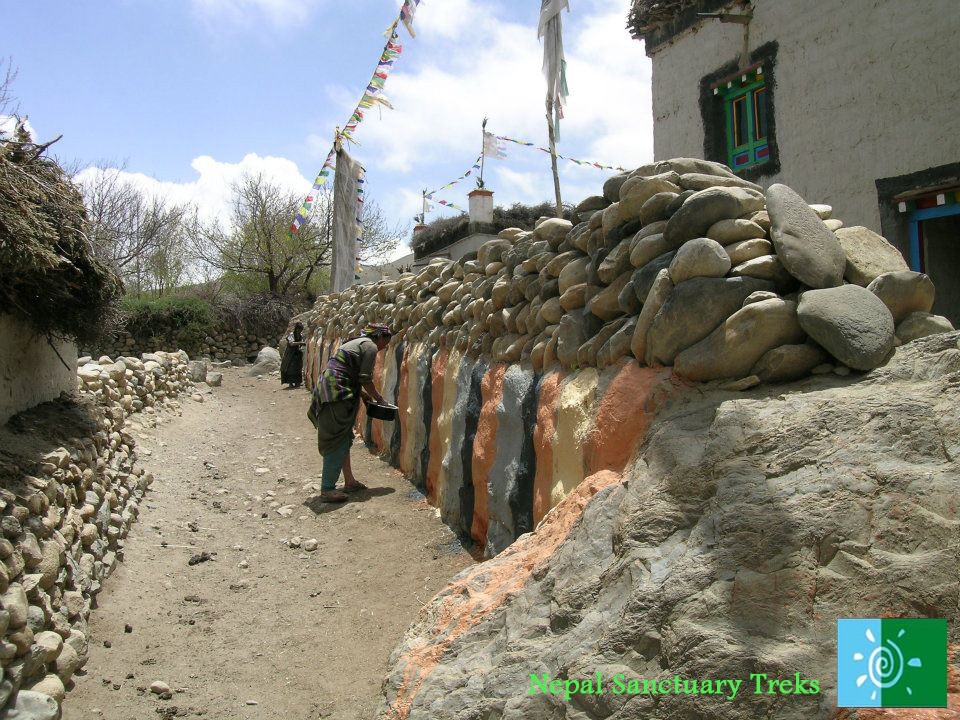
In Ghami, discover a picturesque village of whitewashed stone and mud houses tucked beneath towering cliffs. Walk past a long mani wall, colorful chortens, and traditional water spouts that add to the village’s charm.

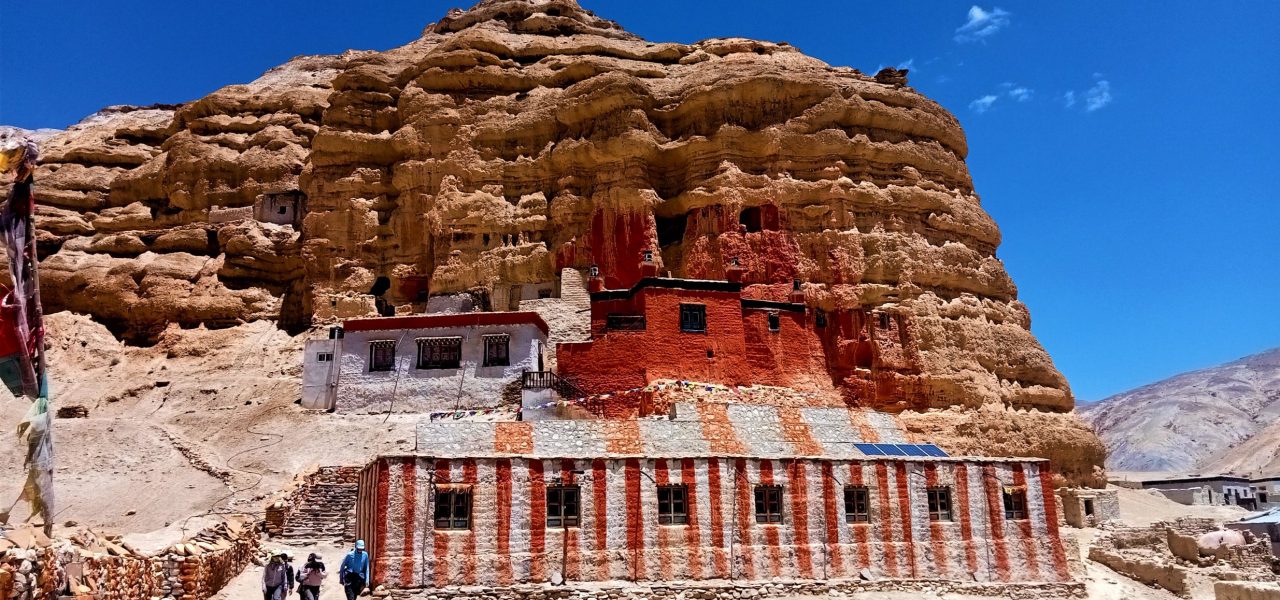
Continue onward to Charang, the second-largest settlement in Upper Mustang after Lo Manthang. Once the region’s capital, Charang is home to the former King’s Palace, which rises prominently above the surrounding homes and fields. Visit the striking 16th-century monastery, easily recognized by its bold red structure and distinctive striped walls, one of the most iconic landmarks in Upper Mustang.

Day 08: Trek Lo Manthang

Altitude above sea level: 3,770 m / 12,371 ft. -Lo Manthang
Hiking duration: Approximately 4–5 hours (16.24 km / 10.09 mi)
Ascent: 506 m / 1,660 ft.
Descent: 251 m / 823 ft.
Accommodation: Teahouse Lodge
Meals: Breakfast, Lunch, and Dinner

After breakfast, begin your trek toward the legendary walled city of Lo Manthang, the cultural heart of Upper Mustang. The trail descends into a scenic canyon, crosses a river, and then climbs steadily to Lo La Pass at 3,950 m (12,959 ft). From the top, enjoy your first breathtaking panoramic view of Lo Manthang, a historic settlement renowned for its ancient heritage and dramatic high-altitude landscapes.

From the pass, follow a gentle downhill trail into Lo Manthang, a traditional walled city with around 150 households, sacred monasteries, and the residences of respected lama gurus, including the home of the King of Lo.

Once inside the city, explore centuries-old monasteries, wander through narrow alleys, and admire the exterior of the royal palace. Spectacular views of Nilgiri, Tilicho, Annapurna I, and Bhrikuti form a stunning Himalayan backdrop, making Lo Manthang one of the most captivating destinations in Upper Mustang.

Day 09: Explore Lo Manthang

Accommodation: Teahouse Lodge
Meals: Breakfast, Lunch, and Dinner

Today is a rest and acclimatization day, giving you time to explore the rich spiritual heritage of Lo Manthang. Inside the medieval walls, you will find four main monasteries. Visit Jampa Lhakhang (built in 1387), known for its towering 50-foot clay statue of Jampa, the Future Buddha. Explore the 15th-century Thubchen Gompa, Chhoede Gompa, home to the local Khempo, and Choprang Gompa.

Alternatively, take a two-hour hike to the hilltop Namgyal Gompa, an important site for religious, social, and legal gatherings that also serves as the local courthouse. From there, continue to the nearby village of Tingkhar, which has around 40 households. Visit Champa Lhakang to see a large Buddha statue and beautifully detailed wall mandalas.

For those seeking adventure, trek to Chhosar to explore the mysterious Jhong (Sky Caves). These multi-story caves are carved into cliffs and remain shrouded in mystery. They are believed to have served as burial chambers, meditation retreats, hiding places, and later monastic sites.

Day 10: Trek to Drakmar

Altitude above sea level: 3,810 m / 12,500 ft.- Drakmar
Hiking duration: Approximately 6–7 hours (17.1 km / 10.62 mi)
Ascent: 840 m / 2,756 ft.
Descent: 835 m / 2,740 ft.
Accommodation: Tea House Lodge
Meals: Breakfast, Lunch, and Dinner

After a hearty breakfast, begin your trek eastward toward a high mountain pass. Cross a broad ridge that opens up sweeping views of the valley below. Along the way, enjoy a mix of natural beauty and cultural highlights.

In the charming village of Gyakar, visit the ancient Ghar Gompa. It is one of the oldest monasteries in the region. It is known for its remarkable rock paintings and deep spiritual significance. According to local belief, every traveler should make a wish here before continuing onward.

After exploring the monastery and making your wish, descend along a steep trail toward the vibrant village of Dhakmar. This village is famous for its striking red cliffs and dramatic landscape. This unique setting makes Dhakmar one of the most visually captivating stops along the Upper Mustang trekking route.

Day 11: Trek to Ghelling

Altitude above sea level: 3,806 m / 12,490 ft.- Ghelling
Hiking duration: 4–5 hours approx. (14.3 km / 8.8 mi)
Ascent: 500 m / 1,640 ft.
Descent: 720 m / 2,362 ft.
Accommodation: Tea House Lodge
Meals: Breakfast, Lunch, and Dinner

After breakfast, begin your trek early to avoid the strong afternoon winds common in this region. The trail descends toward Ghemi and then rejoins the familiar route. It leads you back across Nyi La Pass before arriving again in Ghelling.

Although the windy conditions can make the journey more demanding, the sweeping views of the mighty Dhaulagiri and Nilgiri peaks offer an unforgettable reward along the way.

Day 12: Trek to Chhuksang

Altitude above sea level: 3,050 m / 10,007 ft.-Chhuksang
Hiking duration: 6–7 hours approx. (17 km / 10.56 mi)
Ascent: 400 m / 1,312 ft.
Descent: 900 m / 2,953 ft.
Accommodation: Tea House Lodge
Meals: Breakfast, Lunch, and Dinner

After a hearty breakfast, begin your trek as you retrace the trail toward Lo Manthang. Gradually make your way down to the charming village of Chhuksang.

As you descend to a lower altitude, towering mountain peaks rise dramatically above you. This creates stunning scenery throughout the journey. The route passes through several traditional villages, offering rich cultural encounters and beautiful landscapes before you reach Chhuksang.

Upon arrival, spend the rest of the day exploring the village and immersing yourself in its peaceful Mustang atmosphere.

Day 13: Trek to Jomsom

Altitude above sea level: 2,800 m / 9,186 ft.-Jomsom
Hiking duration: 6–7 hours approx. (22.8 km / 14.16 mi)
Ascent: 400 m / 1,312 ft.
Descent: 618 m / 2,028 ft.
Accommodation: Tea House Lodge
Meals: Breakfast, Lunch, and Dinner

Today, begin your trek back to Jomsom, following the renowned Annapurna Circuit trail. The route offers spectacular views of the Nilgiri Himal and surrounding peaks.

From Chhuksang, it takes approximately four hours to reach the village of Kagbeni. Stop here for lunch before continuing your journey to Jomsom.

The trail passes through traditional villages and beautiful landscapes. This section of the journey is both culturally rich and visually rewarding.

Day 14: Flight to Pokhara- Kathmandu

Flight Duration: Jomsom to Pokhara (25 minutes), Pokhara to Kathmandu (25-30 minutes)
Accommodation: Hotel Tibet or similar
Meals: Breakfast

After an early breakfast, head to Jomsom Airport for your flight. Enjoy one last breathtaking view of the Himalayas before flying to Pokhara and then continuing onward to Kathmandu.

After checking into your hotel, spend a relaxed afternoon at your own pace. You may choose to rest, explore the city, or shop for local handicrafts and souvenirs.

Day 15: Buffer Day

Accommodation: Hotel Tibet or similar
Meals: Breakfast

This day also serves as a buffer in case of bad weather in Jomsom, allowing flexibility if flights are delayed or rescheduled.

Day 16: Final Departure

Meal: Breakfast

As your unforgettable journey comes to an end, it’s time to fly back home, cherishing all the incredible memories of Nepal. A representative from Nepal Sanctuary Treks will transfer you to Tribhuvan International Airport (TIA). Please make sure to check in 3 hours prior to your scheduled flight for a smooth departure.

Price Included

What's Included

  • Private airport transfers,
  • Internal flight Kathmandu-Pokhara-Jomsom- Pokhara-Kathmandu
  • 3 nights in Hotel Tibet or similar in Kathmandu with breakfast,
  • 1 night in Mount Kailash Resort or similar in Pokhara with breakfast
  • Guided Kathmandu sightseeing tour with entrance fees
  • Tea house lodge during the trek on full board
  • Restricted Area Permits, ACAP and TIMS
  • Staff insurance on the trek,
  • Trek guide & porter/s
  • Duffel bag
  • Map

What's not Included

  • Lunch and Dinner in Kathmandu, Pokhara (approx. US$ 20 per day)
  • Beverages
  • Personal equipment,
  • Personal bills,
  • International airfare
  • Excess baggage beyond 15 kilos including day pack Visa fee: US$ 30 for 15 days and US$ 50 for 30 days multiple entries
  • Insurance (for cancellation, accident, health, emergency evacuation and loss, theft of or damage to baggage and personal effects),
  • Liability Insurance
  • Tips

Trip Important Notes

Upper Mustang Trek Packing List – Essential Gear & Clothing

Footwear:

  • Walking boots. A pair of water-repellent boots with ankle support.
  • Walking socks.
  • Yaktrax
  • Trainers or trail shoes. Can be used in and around the lodge in the afternoons/evenings.

Clothing:

  • Waterproof jacket and trousers (Gore-Tex or similar).
  • Trekking trousers.
  • Long sleeve shirts (not cotton).
  • Mid to heavyweight fleece.
  • Sleeveless or body warmer type fleece.
  • Thermals or base layer for top & bottom (merino wool or synthetic).
  • Fleece pants.
  • Medium weight down jacket (e.g.: Nuptse jacket by The North Face).

Hand wear:

  • Fleece gloves.
  • Warms mittens and/or gloves.

Headwear:

  • Wool or fleece hat.
  • Sun hat.
  • Bandana or scarf.
  • Head torch. Bring extra batteries.
  • Sunglasses.

Personal Equipment:

  • Day pack (you’ll need during the day, such as warm clothes, a jacket, a camera, water bottles, snacks, and a personal first aid kit. Keep your daypack under 5 kg. A porter will transport the rest of your personal gear in a duffel or kit bag, which should not exceed 15 kg per trekker. Clearly mark your bag to help identify it easily.)
  • Stuff sacks for keeping your gear dry and organized.
  • Water bottles (Nalgene wide-mouth bottles are the best).
  • Sunscreen and lip salve with a high SPF.
  • Water purification tablets (Aqua Tab, Chlorine dioxide).
  • Favourite snack food.
  • Trekking poles (optional).
  • Camera with spare batteries and memory cards.
  • Insurance certificate.
  • Flash Light
  • Earplugs (optional).
  • Hand sanitizer 
  • Face Mask
  • Spare cash for extra expenses like hot shower, boiled water, gadget charging during trek

Traveling:

  • Bring a small combination padlock to secure the bag.
  • Travel clothes. You will need casual clothing for air travel days and time spent in Kathmandu.
  • Toiletry bags include toilet paper, soap, towel, toothbrush, etc.
  • Quick dry towel

Personal first aid kit: Note: Nepal Sanctuary Treks provides a comprehensive group first aid kit, but please bring personal medications and other items you might use regularly.

Upper Mustang Trek Temperature

The Upper Mustang region has a unique climate due to its location in the rain shadow of the Himalayas. Understanding seasonal temperatures and weather patterns is crucial for planning your trek.

Month Avg. Day Temp (°C) Avg. Night Temp (°C)
Jan – Feb 0 – 5°C -25 – -15°C
March 5 – 15°C -5 – -2°C
April 12 – 20°C -2 – 2°C
May 15 – 22°C 2 – 5°C
June – Aug 16 – 28°C 5 – 10°C
September 12 – 20°C 0 – 6°C
October 10 – 18°C -6 – 3°C
November 5 – 15°C -8 – -2°C
December 0 – 10°C -15 – -5°C

Key Weather Factors

  • Rain Shadow: Upper Mustang stays dry throughout the year, making trekking feasible in most months. Afternoon winds can pick up, so plan accordingly.
  • Strong Winds: Northerly winds in the Kali Gandaki Gorge can reach up to 40 km/h. Start trekking early in the day to avoid peak winds.
  • Cold Nights: Even during summer (June–August), nights at high-altitude locations like Lo Manthang (3,840 m) can approach freezing.

Upper Mustang Trek Accommodation: Teahouses, Lodges & Facilities

Teahouses are available in all major villages along the standard Upper Mustang Trek route, including Kagbeni, Chele, Ghami, Charang, and Lo Manthang. These accommodations are generally clean, well-maintained, and sturdier than the plywood huts found on other treks, offering better protection against the region’s cold desert winds.

Rooms are simple, usually twin-shared with basic bedding, and provide a comfortable place to rest after a day of trekking. Bathrooms are mostly shared, with a mix of Western-style and squat toilets. Hot showers are available for an additional fee of NPR 150–600 (≈ $1–$4 USD), often heated using solar energy.

Each teahouse has a central dining hall, heated by wood or yak dung stoves, which serves as the main space for meals and socializing. Here, trekkers can enjoy local cuisine, meet fellow travelers, and experience the warm hospitality of Upper Mustang’s communities.

Typical day in Teahouse Lodge Trek

A typical day on the Upper Mustang Teahouse Lodge Trek balances trekking, meals, and cultural experiences.

Morning

Each day begins with packing your overnight gear into your main bag before breakfast. Porters set off early to transport luggage while the group enjoys a hearty breakfast. Trekking usually starts around 8 a.m., at a relaxed pace, giving you time to admire the landscape, take photos, and explore local villages.

Midday

Lunch is served at a teahouse along the trail, usually between 11 a.m. and noon, giving you a chance to rest, refuel, and enjoy local flavors before continuing your trek.

Afternoon

After lunch, trekking resumes around 1 p.m., with most days ending at the lodge by mid-afternoon. Upon arrival, you’ll be welcomed with a hot drink and biscuits; perfect for relaxing after the day’s walk.

Evening

Dinner usually includes two courses, such as a warming soup followed by a main dish like dal bhat, momos, or Sherpa stew, with local specialties recommended. After dinner, the trek leader provides a briefing on the next day’s itinerary, ensuring you’re prepared for the journey ahead.

Electricity & Charging on the Upper Mustang Trek

Electricity is available in most major villages and teahouses along the Upper Mustang Trek, though availability and reliability can vary. The region draws power from a mix of the national grid, local micro-hydropower, and solar panels.

In lower villages, some rooms have outlets. However, most teahouses, especially near Lo Manthang, offer charging only in communal dining halls. Fees usually range from NPR 100 to 500 (≈ $1 to $4 USD) per device, with higher charges at higher altitudes. A few lodges provide free charging, but this is uncommon.

Nepal uses Type C and Type D plugs, so bring a universal adapter. Although electricity is generally more reliable than on other remote treks, solar-powered lodges can experience outages during cloudy weather.

Communication on the Upper Mustang Trek

Communication in Upper Mustang is relatively good due to the flat desert terrain. This allows better signal transmission than the deep gorges of the Annapurna region.

A local SIM card is essential for reliable mobile service. Nepal Telecom (NTC) provides the best coverage, offering decent 3G and sometimes 4G in major hubs such as Jomsom, Kagbeni, and Lo Manthang. Ncell works in Jomsom and Kagbeni but often weakens or disappears deeper in the restricted areas toward Charang and Lo Manthang. Expect signal drops at high passes like Nyi La or Lo La and within narrow canyons.

Almost all teahouses along the main circuit offer Wi-Fi, typically costing NPR 200 to 500 ($1.50–$4 USD) for 24 hours.

Upper Mustang Trek Difficulty

The Upper Mustang Trek is moderate in difficulty, with challenges mainly arising from high-altitude endurance, long daily distances, and harsh conditions such as wind and dust. Most of the trek lies between 3,000 m and 3,900 m, with Nyi La Pass (4,010 m) as the highest point. Stay well-hydrated to reduce the risk of mild altitude sickness.

The trails follow ancient caravan routes and dirt roads through a dry, rocky high-altitude desert, featuring gradual but long ascents. Strong afternoon winds from the Kali Gandaki Gorge carry dust, so bring a buff or scarf. Daily hiking typically covers 12 to 16 km over 5 to 7 hours.

Physical Fitness for the Upper Mustang Trek

You don’t need prior trekking experience to complete the Upper Mustang Trek, but you must maintain good physical fitness, strong legs, and mental endurance. Jog, swim, or cycle for 30–45 minutes three times a week to build stamina. Do squats, lunges, and step-ups to strengthen your legs for steady inclines on the trail.

Prepare mentally for the repetitive, stark landscapes and dry, dusty air by practicing patience, staying focused, and maintaining a calm, steady mindset throughout your trek.

ATM & Cash on the Upper Mustang Trek

You will not find reliable ATMs along the Upper Mustang Trek. Functional ATMs exist only in major cities like Kathmandu and Pokhara. Jomsom, the main entry point for Upper Mustang, may have an ATM, but it often runs out of cash, is out of service, or does not accept international cards.

The trek operates entirely on cash. Teahouses, shops, and vendors accept only Nepali Rupees, and smaller villages rarely take credit cards. Carry enough cash to cover extra expenses such as hot showers, device charging, and bottled water.


Faqs

Where is Upper Mustang?

Upper Mustang is a restricted region in Nepal situated in the Trans-Himalayan area near the Tibetan border. It was once an independent kingdom with a rich cultural heritage. Learn more about Upper Mustang

Can I visit other restricted areas in Nepal with the same permit?

 The permit for Upper Mustang is specific to that region and does not grant access to other restricted areas. Separate permits are required for places like Dolpo or Manaslu.


What are the cultural and historical highlights of  the Upper Mustang?

Highlights of the Upper Mustang Trek include the ancient city of Lo Manthang, Tibetan culture, stunning cave monasteries, and dramatic landscapes. Upper Mustang is often referred to as a “Living Museum” due to its well-preserved Tibetan culture. Visit ancient monasteries like Thubchen Gompa and Jampa Gompa, explore cave dwellings, and witness the Tiji Festival. Learn more about Upper Mustang 

Is it possible to do the Upper Mustang Trek solo?

Solo trekking is restricted in Upper Mustang, and trekkers must be part of a group of at least two individuals to obtain a trekking permit. Nepal Sanctuary Treks is here to handle all your permit arrangements for a hassle-free trekking experience. For more information email us at [email protected]

How can I get to the Upper Mustang?

To get to Upper Mustang, start by flying into Kathmandu, then take domestic flights to Pokhara and Jomsom. From Jomsom, you can either trek or drive to Upper Mustang, which requires special permits. Nepal Sanctuary Treks offers customised treks and handles the permit arrangements.

Does the Upper Mustang Trek have internet connectivity?

Internet connectivity in Upper Mustang is inconsistent, with Wi-Fi accessible up to Kagbeni and Lo Manthang. An alternative is using a local GSM-operated SIM card for mobile data (GPRS), although network reliability decreases at higher altitudes. It’s recommended to use the internet sparingly.

Do I need a permit to trek in Upper Mustang?

Yes, a special trekking permit and ACAP are required to enter Upper Mustang, and these permits can be obtained through Nepal Sanctuary Treks.


Are there any restrictions or guidelines for photography in the Upper Mustang?

In the Upper Mustang, always seek permission and respect local customs before taking photos at religious sites and cultural ceremonies to ensure a respectful and enjoyable experience. Learn more on Responsible Travel


Can I combine the Upper Mustang Trek with other treks in the Annapurna region?

Yes, you can combine the Upper Mustang Trek with other treks in the Annapurna region, such as the Annapurna Circuit or Annapurna Base Camp. This allows you to extend your adventure, experience diverse landscapes, and explore the rich cultural and natural beauty of the region. Combining these treks offers a more comprehensive experience of the Himalayas. Nepal Sanctuary Treks curate the trekking experiences based on your preferences, time-frame and physical fitness.

Can I get access to ATMs or exchange money in Upper Mustang?

ATM access is limited, so make sure to carry sufficient Nepali currency for your trek. You might need spare cash for charging device, boiled water and hot shower. Exchange or withdraw money in Kathmandu or Pokhara before traveling to Jomsom.

Where in Tribhuvan airport I will be paying my visa fee?  I’ve already completed the application online but I’m unclear where I make my payment at the airport.  

Since you completed the process online, you will receive a submission receipt with a barcode. Please print this receipt and bring it with you when you visit the visa fees collection counter. Make sure about the type of visa you will need (15 days, 30 days, or 90 days) and make the payment accordingly. We recommend you bring the exact amount in US currency of the current visa fee while paying at the visa counter.

Next, you should head to the Immigration Desk, taking along your online application form, payment receipts, and your passport. Hand over these documents to the immigration officer to initiate the visa processing procedure.

How do Nepal Sanctuary Treks guides keep clients safe during treks?

Monitoring Health: Guides use oximeters to check clients’ oxygen levels daily, carry a first aid kit, and utilize the Lake Louise Form to monitor altitude sickness.

Communication: They are equipped with local SIM cards and satellite phones for continuous updates.

Emergency Response: In emergencies, they promptly notify the Kathmandu office and CIWEC clinic and are prepared to arrange critical support, including helicopter evacuations for severe medical issues.

Do I need travel insurance covered while trekking/traveling in Nepal?

Travel insurance is compulsory for all our travelers and should be taken out at the time of booking.  We recommend that you take out insurance as soon as your booking is confirmed. The insurance must comprise medical coverage, helicopter rescue, and ambulance services.  Read more about Travel Insurance

Can I rent or buy trekking equipment in Nepal?

Yes, you can rent or purchase trekking gear in Kathmandu or Pokhara, including items like sleeping bags, down jackets, and trekking poles. Make sure to check the quality and condition of rented equipment. For instance, sleeping bags are available for rent at rates ranging from USD 1 to USD 1.50 per day. For more information, please contact [email protected].

Are there any health risks or altitude sickness concerns on the trek?

Altitude sickness can be a serious risk for trekkers at high elevations, so it’s important to acclimatize properly. Start slowly to give your body time to adjust, and stay hydrated, as dehydration can worsen symptoms. Watch for signs of altitude sickness, like headaches, nausea, and dizziness. Consulting a healthcare professional before your Nepal trek can provide helpful advice for a safer experience. The team at Nepal Sanctuary Treks carries a portable altitude chamber (PAC), an oximeter, and the Lake Louise form during the trek. They monitor each traveler’s condition and track their progress. Additionally, the expert team at Nepal Sanctuary Treks carefully designs itineraries that include acclimatization days, allowing trekkers to gradually adjust to the changing altitude. These carefully planned rest days are strategically placed throughout the trek to help minimize the risk of altitude sickness. . Read more on Altitude Sickness

Ask Our Travel Expert

Affiliations & Recommendations

Upper Mustang Trek